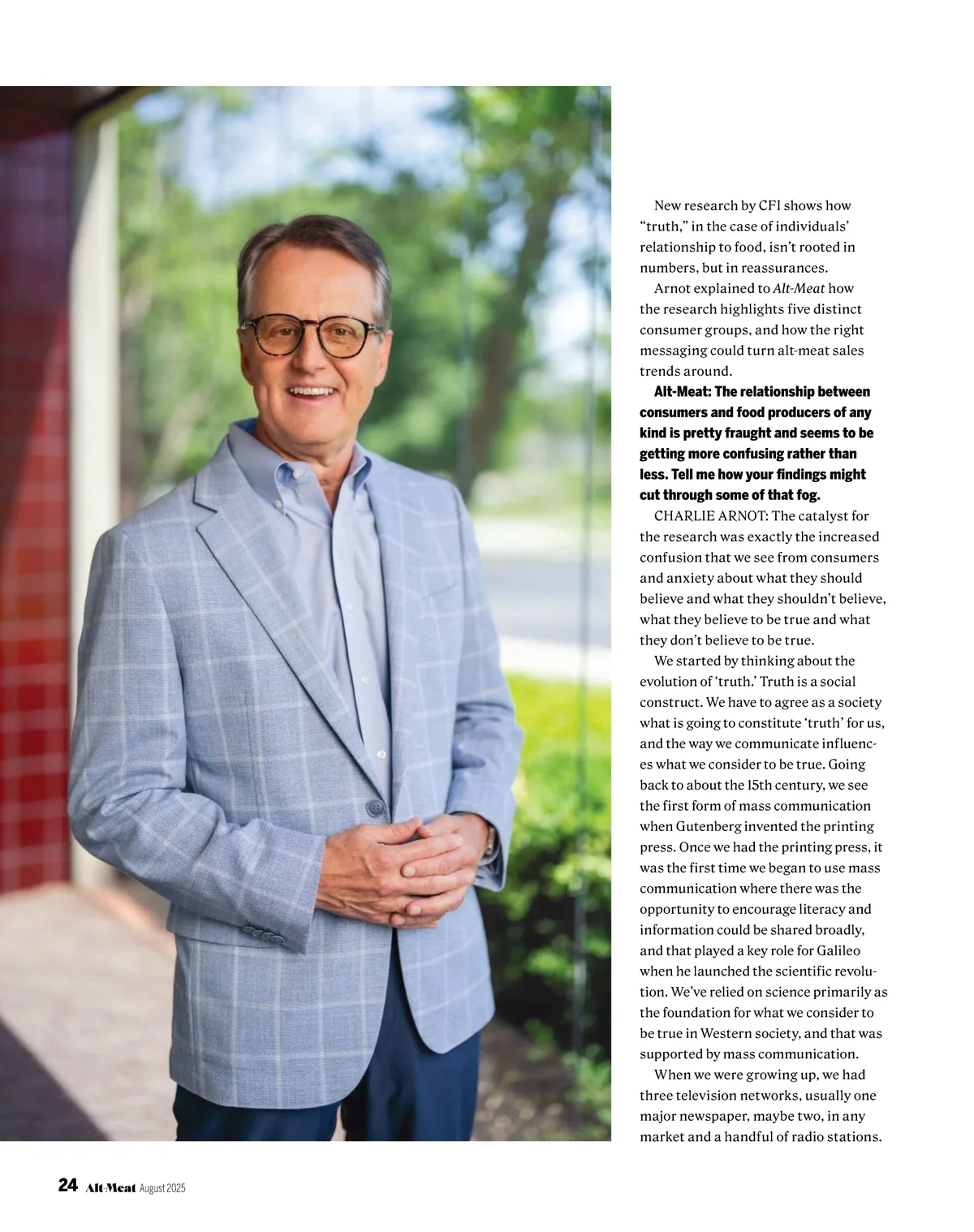
New research by CFI shows how “truth,” in the case of individuals’ relationship to food, isn’t rooted in numbers, but in reassurances. Arnot explained to Alt-Meat how the research highlights five distinct consumer groups, and how the right messaging could turn alt-meat sales trends around. Alt-Meat: The relationship between consumers and food producers of any kind is pretty fraught and seems to be getting more confusing rather than less. Tell me how your findings might cut through some of that fog. CHARLIE ARNOT: The catalyst for the research was exactly the increased confusion that we see from consumers and anxiety about what they should believe and what they shouldn’t believe, what they believe to be true and what they don’t believe to be true. We started by thinking about the evolution of ‘truth.’ Truth is a social construct. We have to agree as a society what is going to constitute ‘truth’ for us, and the way we communicate influenc-es what we consider to be true. Going back to about the 15th century, we see the first form of mass communication when Gutenberg invented the printing press. Once we had the printing press, it was the first time we began to use mass communication where there was the opportunity to encourage literacy and information could be shared broadly, and that played a key role for Galileo when he launched the scientific revolu-tion. We’ve relied on science primarily as the foundation for what we consider to be true in Western society, and that was supported by mass communication. When we were growing up, we had three television networks, usually one major newspaper, maybe two, in any market and a handful of radio stations. 24 Alt-Meat August 2025
Alt-Meat August 2025: Page 24