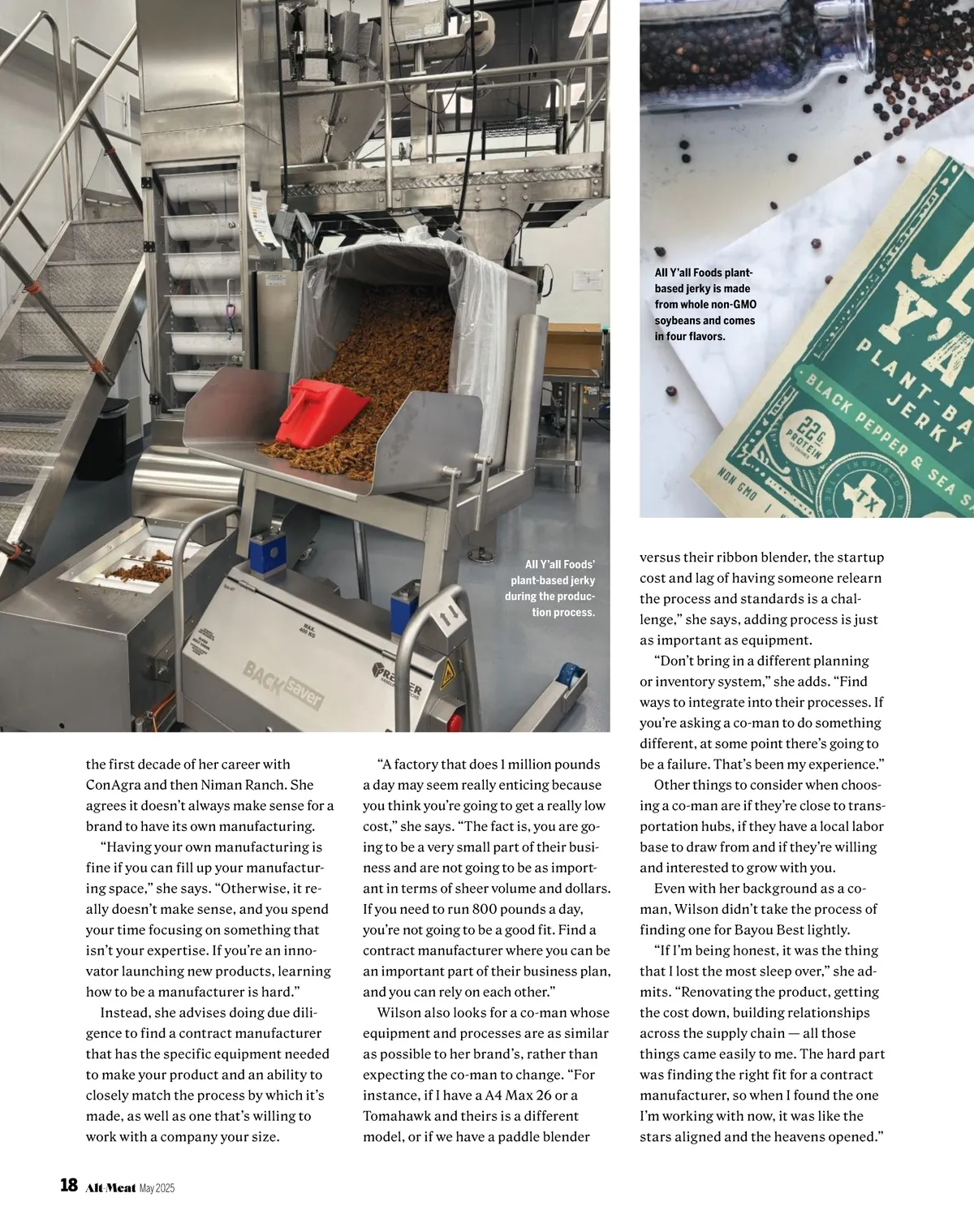
Manufacturing All Y’all Foods plant-based jerky is made from whole non-GMO soybeans and comes in four flavors. All Y’all Foods’ plant-based jerky during the produc-tion process. versus their ribbon blender, the startup cost and lag of having someone relearn the process and standards is a chal-lenge,” she says, adding process is just as important as equipment. “Don’t bring in a different planning or inventory system,” she adds. “Find ways to integrate into their processes. If you’re asking a co-man to do something different, at some point there’s going to the first decade of her career with ConAgra and then Niman Ranch. She agrees it doesn’t always make sense for a brand to have its own manufacturing. “Having your own manufacturing is fine if you can fill up your manufactur-ing space,” she says. “Otherwise, it re-ally doesn’t make sense, and you spend your time focusing on something that isn’t your expertise. If you’re an inno-vator launching new products, learning how to be a manufacturer is hard.” Instead, she advises doing due dili-gence to find a contract manufacturer that has the specific equipment needed to make your product and an ability to closely match the process by which it’s made, as well as one that’s willing to work with a company your size. “A factory that does 1 million pounds a day may seem really enticing because you think you’re going to get a really low cost,” she says. “The fact is, you are go-ing to be a very small part of their busi-ness and are not going to be as import-ant in terms of sheer volume and dollars. If you need to run 800 pounds a day, you’re not going to be a good fit. Find a contract manufacturer where you can be an important part of their business plan, and you can rely on each other.” Wilson also looks for a co-man whose equipment and processes are as similar as possible to her brand’s, rather than expecting the co-man to change. “For instance, if I have a A4 Max 26 or a Tomahawk and theirs is a different model, or if we have a paddle blender be a failure. That’s been my experience.” Other things to consider when choos-ing a co-man are if they’re close to trans-portation hubs, if they have a local labor base to draw from and if they’re willing and interested to grow with you. Even with her background as a co-man, Wilson didn’t take the process of finding one for Bayou Best lightly. “If I’m being honest, it was the thing that I lost the most sleep over,” she ad-mits. “Renovating the product, getting the cost down, building relationships across the supply chain — all those things came easily to me. The hard part was finding the right fit for a contract manufacturer, so when I found the one I’m working with now, it was like the stars aligned and the heavens opened.” 18 Alt-Meat May 2025
Alt-Meat May 2025: Page 18