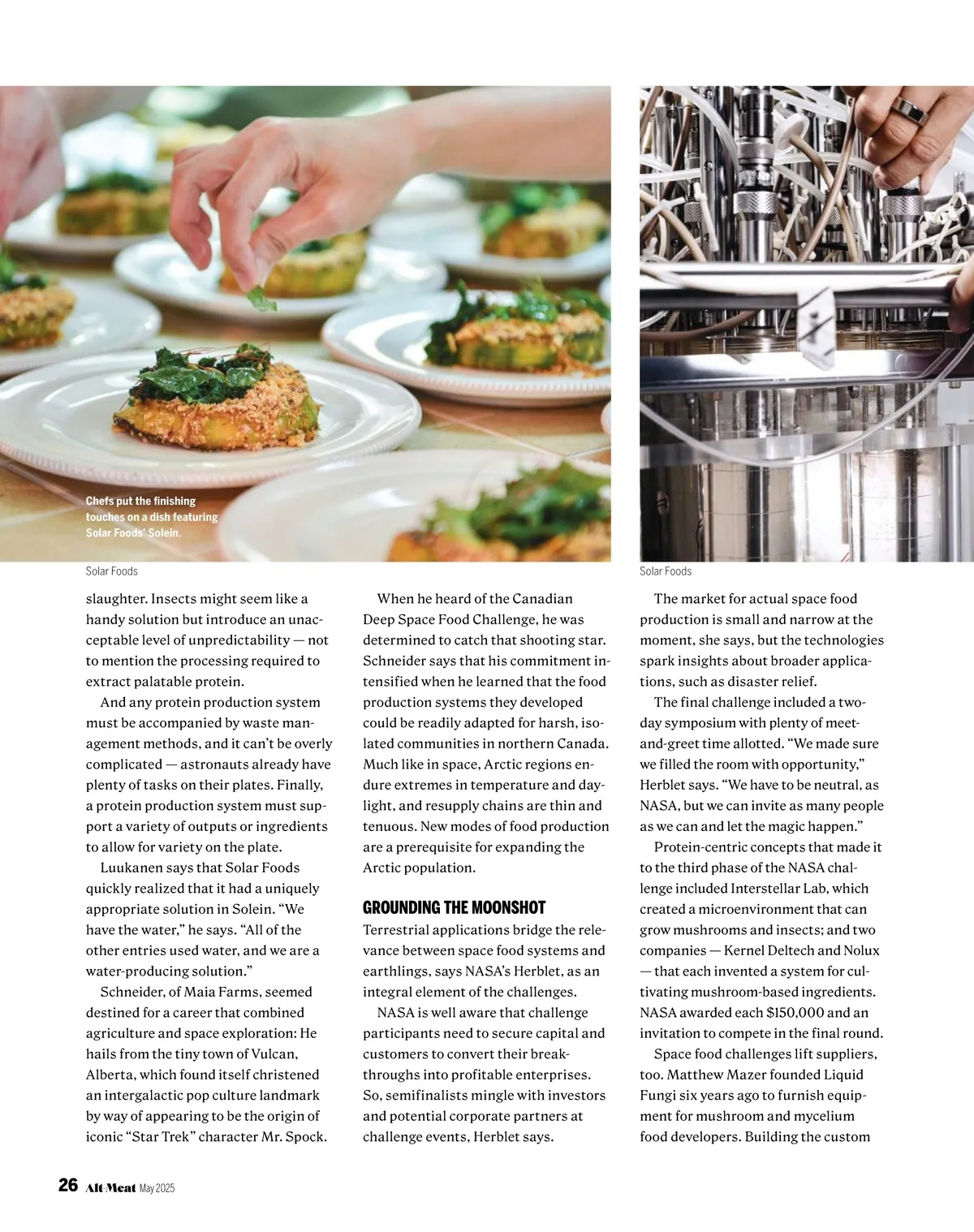
Chefs put the finishing touches on a dish featuring Solar Foods’ Solein. Solar Foods Solar Foods slaughter. Insects might seem like a handy solution but introduce an unac-ceptable level of unpredictability — not to mention the processing required to extract palatable protein. And any protein production system must be accompanied by waste man-agement methods, and it can’t be overly complicated — astronauts already have plenty of tasks on their plates. Finally, a protein production system must sup-port a variety of outputs or ingredients to allow for variety on the plate. Luukanen says that Solar Foods quickly realized that it had a uniquely appropriate solution in Solein. “We have the water,” he says. “All of the other entries used water, and we are a water-producing solution.” Schneider, of Maia Farms, seemed destined for a career that combined agriculture and space exploration: He hails from the tiny town of Vulcan, Alberta, which found itself christened an intergalactic pop culture landmark by way of appearing to be the origin of iconic “Star Trek” character Mr. Spock. When he heard of the Canadian Deep Space Food Challenge, he was determined to catch that shooting star. Schneider says that his commitment in-tensified when he learned that the food production systems they developed could be readily adapted for harsh, iso-lated communities in northern Canada. Much like in space, Arctic regions en-dure extremes in temperature and day-light, and resupply chains are thin and tenuous. New modes of food production are a prerequisite for expanding the Arctic population. The market for actual space food production is small and narrow at the moment, she says, but the technologies spark insights about broader applica-tions, such as disaster relief. The final challenge included a two-day symposium with plenty of meet-and-greet time allotted. “We made sure we filled the room with opportunity,” Herblet says. “We have to be neutral, as NASA, but we can invite as many people as we can and let the magic happen.” Protein-centric concepts that made it to the third phase of the NASA chal-lenge included Interstellar Lab, which created a microenvironment that can grow mushrooms and insects; and two companies — Kernel Deltech and Nolux — that each invented a system for cul-tivating mushroom-based ingredients. NASA awarded each $150,000 and an invitation to compete in the final round. Space food challenges lift suppliers, too. Matthew Mazer founded Liquid Fungi six years ago to furnish equip-ment for mushroom and mycelium food developers. Building the custom GROUNDING THE MOONSHOT Terrestrial applications bridge the rele-vance between space food systems and earthlings, says NASA’s Herblet, as an integral element of the challenges. NASA is well aware that challenge participants need to secure capital and customers to convert their break-throughs into profitable enterprises. So, semifinalists mingle with investors and potential corporate partners at challenge events, Herblet says. 26 Alt-Meat May 2025
Alt-Meat May 2025: Page 26