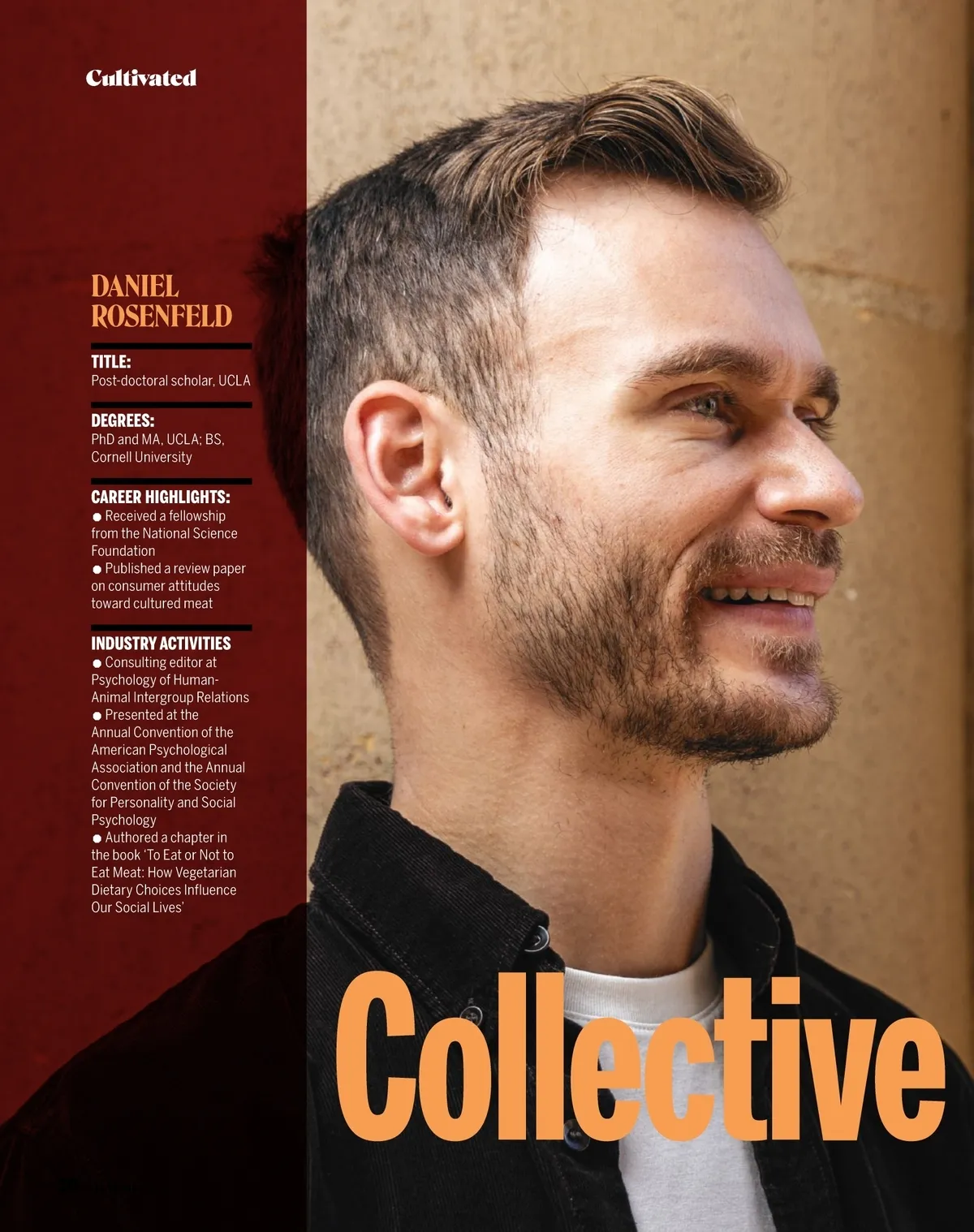
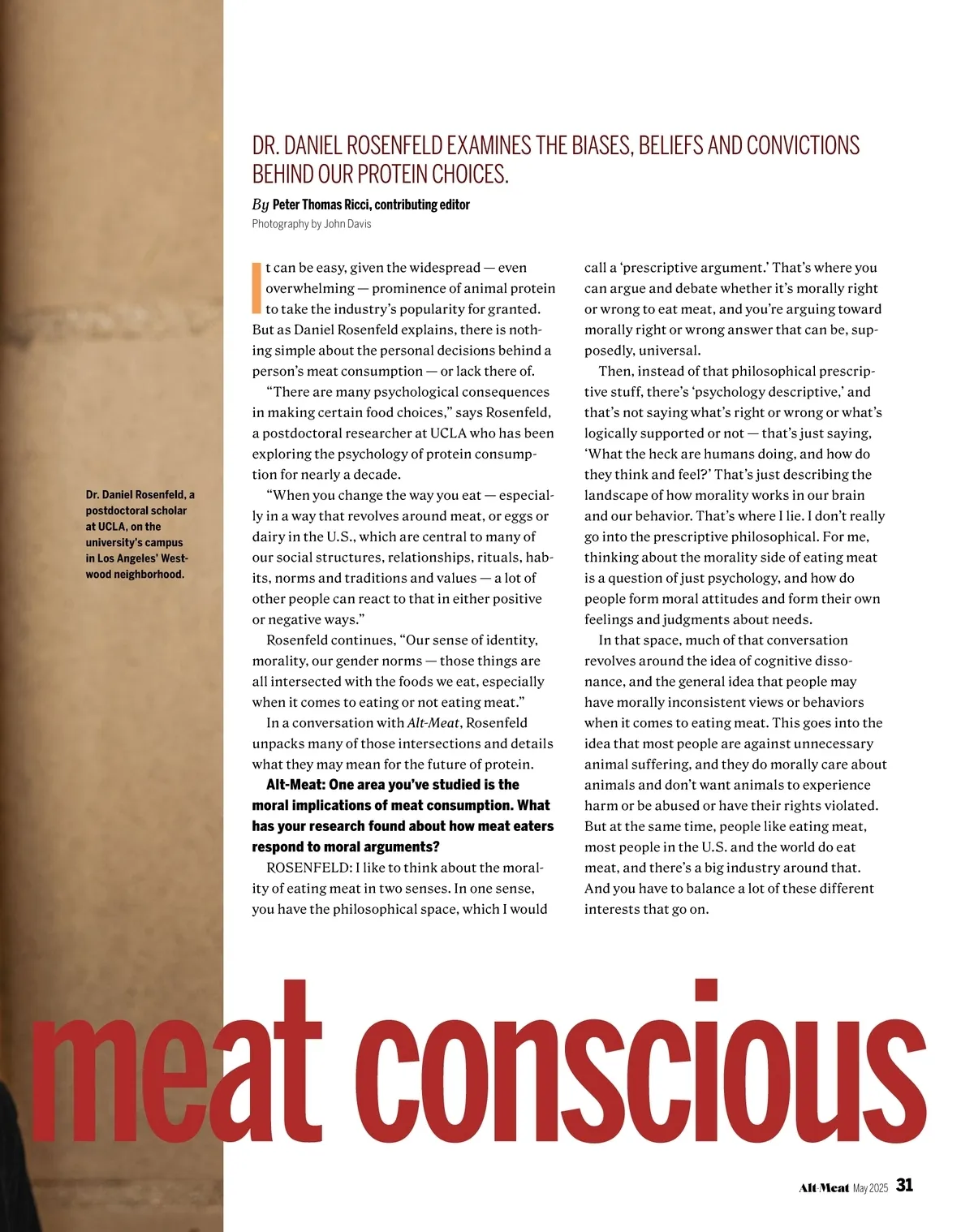
DR. DANIEL ROSENFELD EXAMINES THE BIASES, BELIEFS AND CONVICTIONS BEHIND OUR PROTEIN CHOICES. By Peter Thomas Ricci, contributing editor Photography by John Davis I Dr. Daniel Rosenfeld, a postdoctoral scholar at UCLA, on the university’s campus in Los Angeles’ West-wood neighborhood. t can be easy, given the widespread — even overwhelming — prominence of animal protein to take the industry’s popularity for granted. call a ‘prescriptive argument.’ That’s where you can argue and debate whether it’s morally right or wrong to eat meat, and you’re arguing toward morally right or wrong answer that can be, sup-posedly, universal. Then, instead of that philosophical prescrip-tive stuff, there’s ‘psychology descriptive,’ and that’s not saying what’s right or wrong or what’s logically supported or not — that’s just saying, ‘What the heck are humans doing, and how do they think and feel?’ That’s just describing the landscape of how morality works in our brain and our behavior. That’s where I lie. I don’t really go into the prescriptive philosophical. For me, thinking about the morality side of eating meat is a question of just psychology, and how do people form moral attitudes and form their own feelings and judgments about needs. In that space, much of that conversation revolves around the idea of cognitive disso-nance, and the general idea that people may have morally inconsistent views or behaviors when it comes to eating meat. This goes into the idea that most people are against unnecessary animal suffering, and they do morally care about animals and don’t want animals to experience harm or be abused or have their rights violated. But at the same time, people like eating meat, most people in the U.S. and the world do eat meat, and there’s a big industry around that. And you have to balance a lot of these different interests that go on. But as Daniel Rosenfeld explains, there is noth-ing simple about the personal decisions behind a person’s meat consumption — or lack there of. “There are many psychological consequences in making certain food choices,” says Rosenfeld, a postdoctoral researcher at UCLA who has been exploring the psychology of protein consump-tion for nearly a decade. “When you change the way you eat — especial-ly in a way that revolves around meat, or eggs or dairy in the U.S., which are central to many of our social structures, relationships, rituals, hab-its, norms and traditions and values — a lot of other people can react to that in either positive or negative ways.” Rosenfeld continues, “Our sense of identity, morality, our gender norms — those things are all intersected with the foods we eat, especially when it comes to eating or not eating meat.” In a conversation with Alt-Meat , Rosenfeld unpacks many of those intersections and details what they may mean for the future of protein. Alt-Meat: One area you’ve studied is the moral implications of meat consumption. What has your research found about how meat eaters respond to moral arguments? ROSENFELD: I like to think about the moral-ity of eating meat in two senses. In one sense, you have the philosophical space, which I would meat conscious Alt-Meat May 2025 31
Alt-Meat May 2025: Page 31