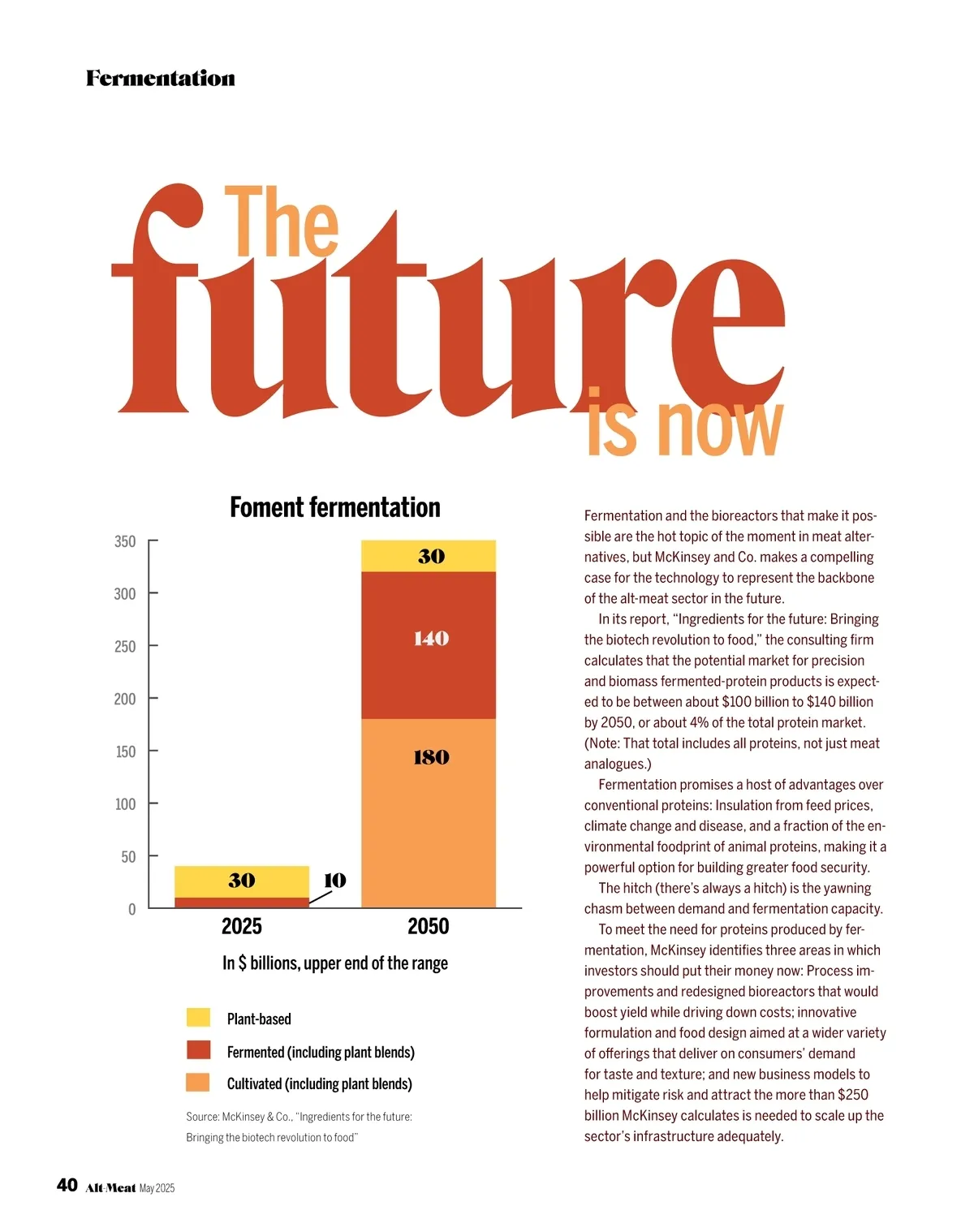
Fermentation future The is now Foment fermentation 30 140 150 100 50 0 350 300 250 200 180 30 10 2025 2050 In $ billions, upper end of the range Plant-based Fermented (including plant blends) Cultivated (including plant blends) Source: McKinsey & Co., “Ingredients for the future: Bringing the biotech revolution to food” Fermentation and the bioreactors that make it pos-sible are the hot topic of the moment in meat alter-natives, but McKinsey and Co. makes a compelling case for the technology to represent the backbone of the alt-meat sector in the future. In its report, “Ingredients for the future: Bringing the biotech revolution to food,” the consulting firm calculates that the potential market for precision and biomass fermented-protein products is expect-ed to be between about $100 billion to $140 billion by 2050, or about 4% of the total protein market. (Note: That total includes all proteins, not just meat analogues.) Fermentation promises a host of advantages over conventional proteins: Insulation from feed prices, climate change and disease, and a fraction of the en-vironmental foodprint of animal proteins, making it a powerful option for building greater food security. The hitch (there’s always a hitch) is the yawning chasm between demand and fermentation capacity. To meet the need for proteins produced by fer-mentation, McKinsey identifies three areas in which investors should put their money now: Process im-provements and redesigned bioreactors that would boost yield while driving down costs; innovative formulation and food design aimed at a wider variety of offerings that deliver on consumers’ demand for taste and texture; and new business models to help mitigate risk and attract the more than $250 billion McKinsey calculates is needed to scale up the sector’s infrastructure adequately. 40 Alt-Meat May 2025
Alt-Meat May 2025: Page 40