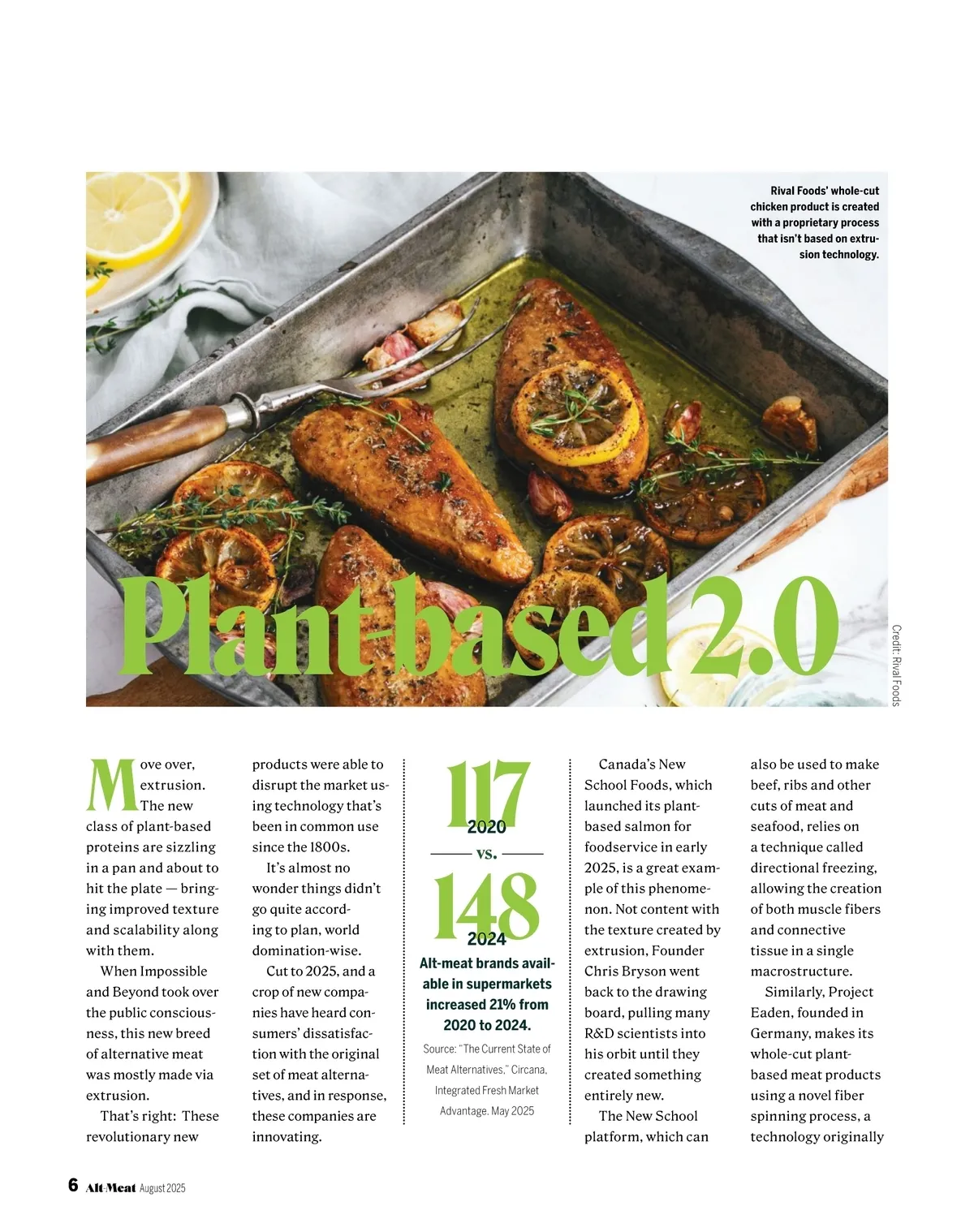
Rival Foods’ whole-cut chicken product is created with a proprietary process that isn’t based on extru-sion technology. Plant-based 2.0 M ove over, extrusion. The new products were able to disrupt the market us-ing technology that’s been in common use since the 1800s. It’s almost no wonder things didn’t go quite accord-ing to plan, world domination-wise. Cut to 2025, and a crop of new compa-nies have heard con-sumers’ dissatisfac-tion with the original set of meat alterna-tives, and in response, these companies are innovating. class of plant-based proteins are sizzling in a pan and about to hit the plate — bring-ing improved texture and scalability along with them. When Impossible and Beyond took over the public conscious-ness, this new breed of alternative meat was mostly made via extrusion. That’s right: These revolutionary new Credit: Rival Foods Alt-meat brands avail-able in supermarkets increased 21% from 2020 to 2024. Source: “The Current State of Meat Alternatives,” Circana, Integrated Fresh Market Advantage. May 2025 117 148 2020 vs. 2024 Canada’s New School Foods, which launched its plant-based salmon for foodservice in early 2025, is a great exam-ple of this phenome-non. Not content with the texture created by extrusion, Founder Chris Bryson went back to the drawing board, pulling many R&D scientists into his orbit until they created something entirely new. The New School platform, which can also be used to make beef, ribs and other cuts of meat and seafood, relies on a technique called directional freezing, allowing the creation of both muscle fibers and connective tissue in a single macrostructure. Similarly, Project Eaden, founded in Germany, makes its whole-cut plant-based meat products using a novel fiber spinning process, a technology originally 6 Alt-Meat August 2025
Alt-Meat August 2025: Page 6