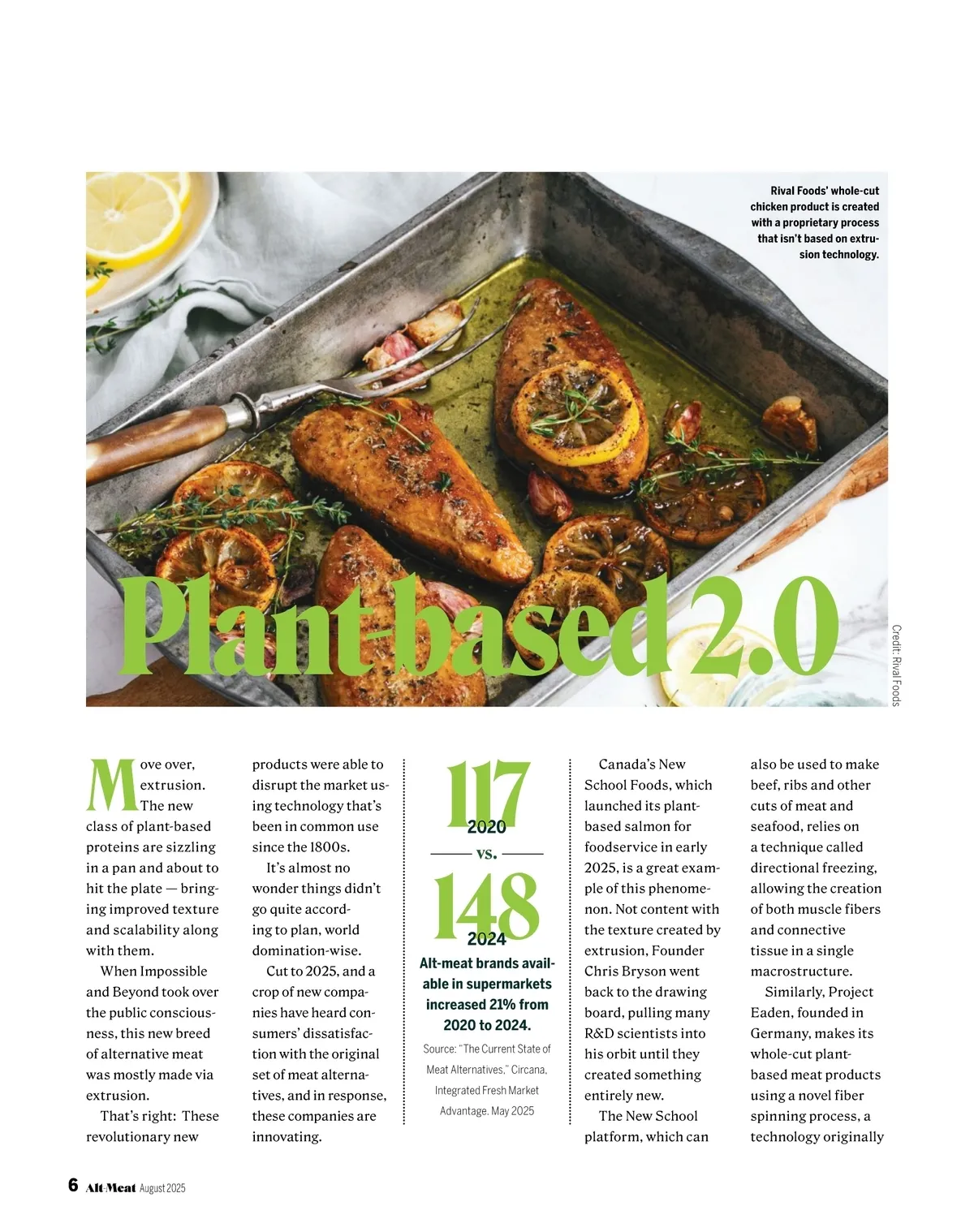
Trending developed for use in the textile industry. The process is not unlike making cotton candy, with viscous wheat, pea, and fava bean proteins shot out of a spinneret, which forces them to quickly phase change to solid, forming tiny strands in multiple shapes and sizes. Project Eaden brings the fibers together with a proprietary compounding technique to create specific shapes, like a breast or filet. On the b2b side, Rival Foods, a spinoff from Wageningen University, is creat-ing whole cuts with what they call shear cell technology. The company’s patented process is sort of like a pressure cook-er, using heat and pressure — just a lot less than is typically used during extru-sion. The process creates larger, whole cuts and gives Rival more control over the texture of the final product, which can be fibrous or flaky depending on the processing conditions. Much like Bryson’s directional freez-ing technique and Project Eaden’s fiber spinning process, Rival Foods says its approach is versa-tile across different types of meat and is scalable. “Historically, the taste is often disappointing, sometimes extremely. But recently, I’ve tasted more and more products that are quite impressive.” —David Lobell, a food and agriculture expert from Stanford University, on why consumers have strug-gled to adopt plant-based meat Your trusted technical partner in plant-based meat alternative expertise and ingenuity Alt-Meat August 2025 7
Alt-Meat August 2025: Page 7