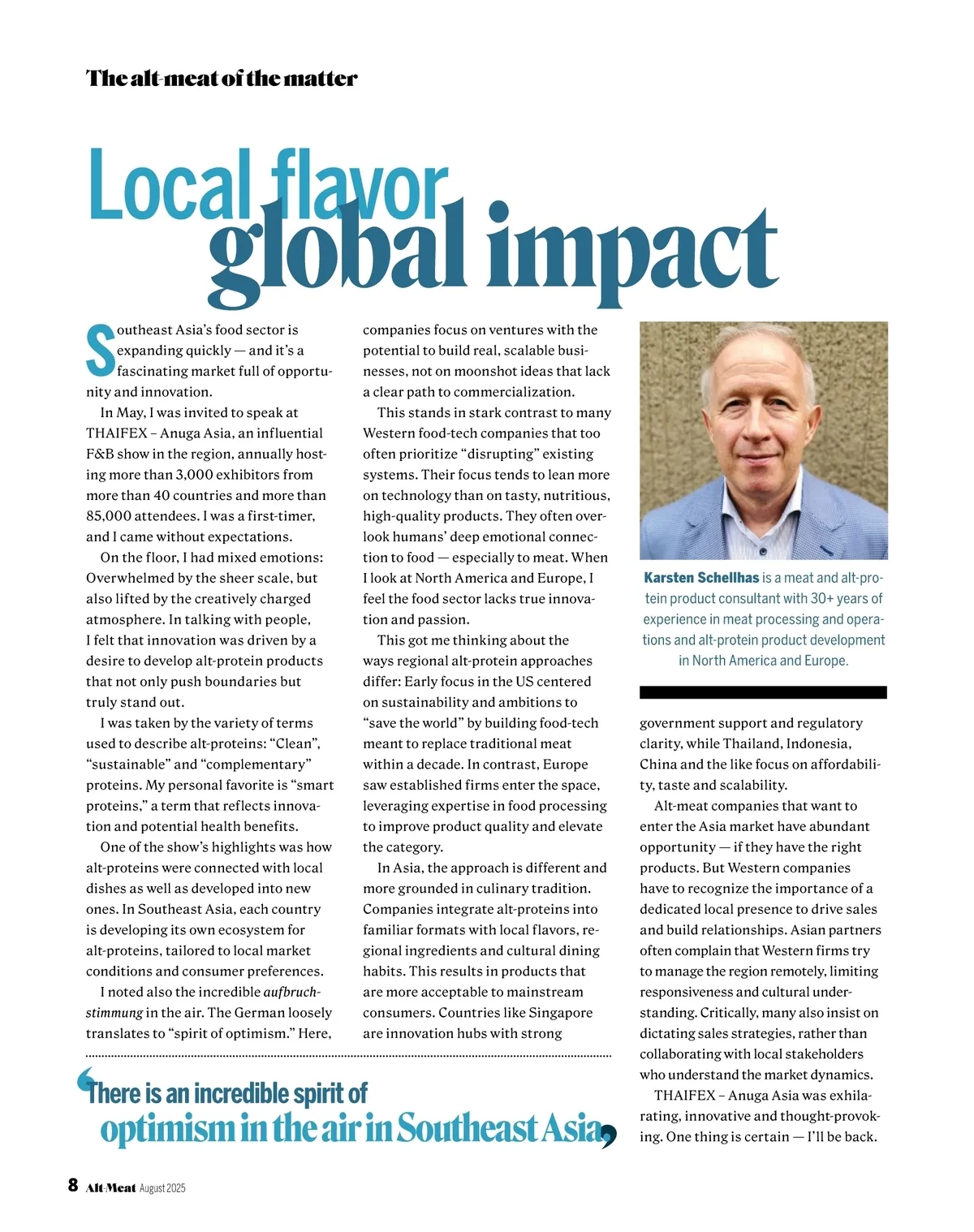
The alt-meat of the matter Local flavor, S outheast Asia’s food sector is expanding quickly — and it’s a fascinating market full of opportu-nity and innovation. In May, I was invited to speak at THAIFEX – Anuga Asia, an influential F&B show in the region, annually host-ing more than 3,000 exhibitors from more than 40 countries and more than 85,000 attendees. I was a first-timer, and I came without expectations. On the floor, I had mixed emotions: Overwhelmed by the sheer scale, but also lifted by the creatively charged atmosphere. In talking with people, I felt that innovation was driven by a desire to develop alt-protein products that not only push boundaries but truly stand out. I was taken by the variety of terms used to describe alt-proteins: “Clean”, “sustainable” and “complementary” proteins. My personal favorite is “smart proteins,” a term that reflects innova-tion and potential health benefits. One of the show’s highlights was how alt-proteins were connected with local dishes as well as developed into new ones. In Southeast Asia, each country is developing its own ecosystem for alt-proteins, tailored to local market conditions and consumer preferences. I noted also the incredible aufbruch-stimmung in the air. The German loosely translates to “spirit of optimism.” Here, global impact companies focus on ventures with the potential to build real, scalable busi-nesses, not on moonshot ideas that lack a clear path to commercialization. This stands in stark contrast to many Western food-tech companies that too often prioritize “disrupting” existing systems. Their focus tends to lean more on technology than on tasty, nutritious, high-quality products. They often over-look humans’ deep emotional connec-tion to food — especially to meat. When I look at North America and Europe, I feel the food sector lacks true innova-tion and passion. This got me thinking about the ways regional alt-protein approaches differ: Early focus in the US centered on sustainability and ambitions to “save the world” by building food-tech meant to replace traditional meat within a decade. In contrast, Europe saw established firms enter the space, leveraging expertise in food processing to improve product quality and elevate the category. In Asia, the approach is different and more grounded in culinary tradition. Companies integrate alt-proteins into familiar formats with local flavors, re-gional ingredients and cultural dining habits. This results in products that are more acceptable to mainstream consumers. Countries like Singapore are innovation hubs with strong government support and regulatory clarity, while Thailand, Indonesia, China and the like focus on affordabili-ty, taste and scalability. Alt-meat companies that want to enter the Asia market have abundant opportunity — if they have the right products. But Western companies have to recognize the importance of a dedicated local presence to drive sales and build relationships. Asian partners often complain that Western firms try to manage the region remotely, limiting responsiveness and cultural under-standing. Critically, many also insist on dictating sales strategies, rather than collaborating with local stakeholders who understand the market dynamics. THAIFEX – Anuga Asia was exhila-rating, innovative and thought-provok-ing. One thing is certain — I’ll be back. Karsten Schellhas is a meat and alt-pro-tein product consultant with 30+ years of experience in meat processing and opera-tions and alt-protein product development in North America and Europe. There is an incredible spirit of 8 Alt-Meat August 2025 optimism in the air in Southeast Asia.
Alt-Meat August 2025: Page 8