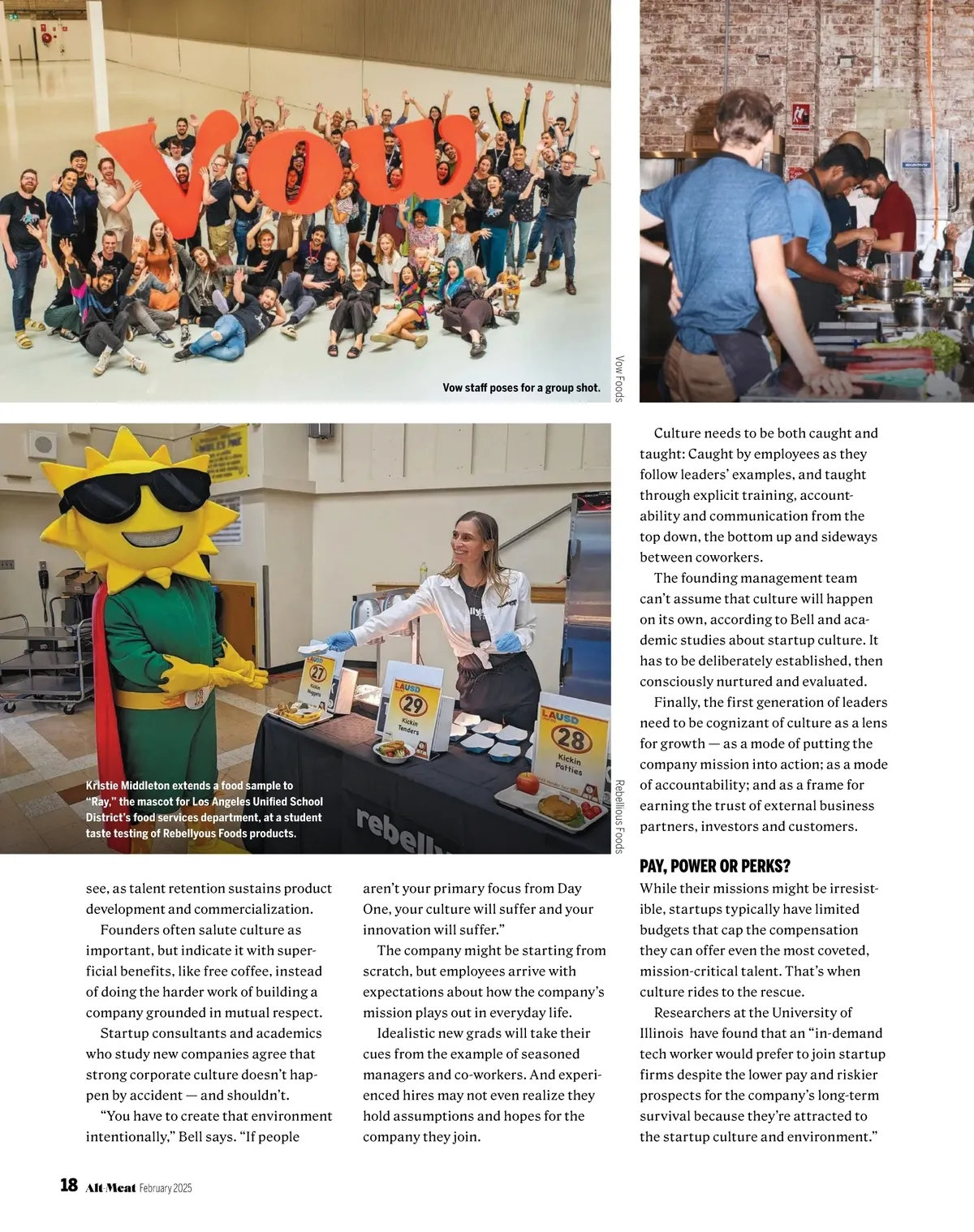
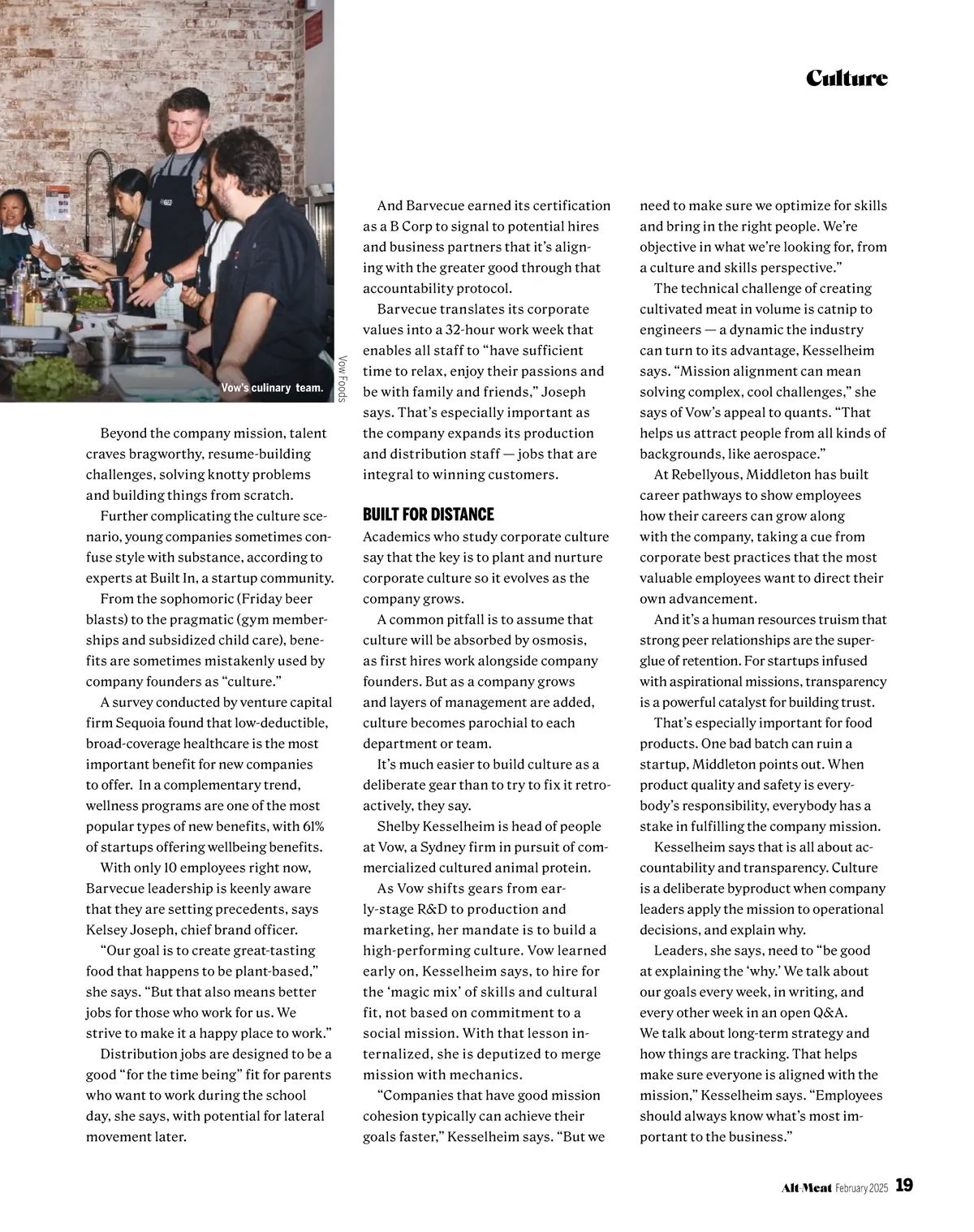
Culture And Barvecue earned its certification as a B Corp to signal to potential hires and business partners that it’s align-ing with the greater good through that accountability protocol. Barvecue translates its corporate values into a 32-hour work week that enables all staff to “have sufficient time to relax, enjoy their passions and be with family and friends,” Joseph says. That’s especially important as the company expands its production and distribution staff — jobs that are integral to winning customers. Vow Foods need to make sure we optimize for skills and bring in the right people. We’re objective in what we’re looking for, from a culture and skills perspective.” The technical challenge of creating cultivated meat in volume is catnip to engineers — a dynamic the industry can turn to its advantage, Kesselheim says. “Mission alignment can mean solving complex, cool challenges,” she says of Vow’s appeal to quants. “That helps us attract people from all kinds of backgrounds, like aerospace.” At Rebellyous, Middleton has built career pathways to show employees how their careers can grow along with the company, taking a cue from corporate best practices that the most valuable employees want to direct their own advancement. And it’s a human resources truism that strong peer relationships are the super-glue of retention. For startups infused with aspirational missions, transparency is a powerful catalyst for building trust. That’s especially important for food products. One bad batch can ruin a startup, Middleton points out. When product quality and safety is every-body’s responsibility, everybody has a stake in fulfilling the company mission. Kesselheim says that is all about ac-countability and transparency. Culture is a deliberate byproduct when company leaders apply the mission to operational decisions, and explain why. Leaders, she says, need to “be good at explaining the ‘why.’ We talk about our goals every week, in writing, and every other week in an open Q&A. We talk about long-term strategy and how things are tracking. That helps make sure everyone is aligned with the mission,” Kesselheim says. “Employees should always know what’s most im-portant to the business.” Alt-Meat February 2025 Vow’s culinary team. Beyond the company mission, talent craves bragworthy, resume-building challenges, solving knotty problems and building things from scratch. Further complicating the culture sce-nario, young companies sometimes con-fuse style with substance, according to experts at Built In, a startup community. From the sophomoric (Friday beer blasts) to the pragmatic (gym member-ships and subsidized child care), bene-fits are sometimes mistakenly used by company founders as “culture.” A survey conducted by venture capital firm Sequoia found that low-deductible, broad-coverage healthcare is the most important benefit for new companies to offer. In a complementary trend, wellness programs are one of the most popular types of new benefits, with 61% of startups offering wellbeing benefits. With only 10 employees right now, Barvecue leadership is keenly aware that they are setting precedents, says Kelsey Joseph, chief brand officer. “Our goal is to create great-tasting food that happens to be plant-based,” she says. “But that also means better jobs for those who work for us. We strive to make it a happy place to work.” Distribution jobs are designed to be a good “for the time being” fit for parents who want to work during the school day, she says, with potential for lateral movement later. BUILT FOR DISTANCE Academics who study corporate culture say that the key is to plant and nurture corporate culture so it evolves as the company grows. A common pitfall is to assume that culture will be absorbed by osmosis, as first hires work alongside company founders. But as a company grows and layers of management are added, culture becomes parochial to each department or team. It’s much easier to build culture as a deliberate gear than to try to fix it retro-actively, they say. Shelby Kesselheim is head of people at Vow, a Sydney firm in pursuit of com-mercialized cultured animal protein. As Vow shifts gears from ear-ly-stage R&D to production and marketing, her mandate is to build a high-performing culture. Vow learned early on, Kesselheim says, to hire for the ‘magic mix’ of skills and cultural fit, not based on commitment to a social mission. With that lesson in-ternalized, she is deputized to merge mission with mechanics. “Companies that have good mission cohesion typically can achieve their goals faster,” Kesselheim says. “But we 19
Alt-Meat February 2025: Page 19