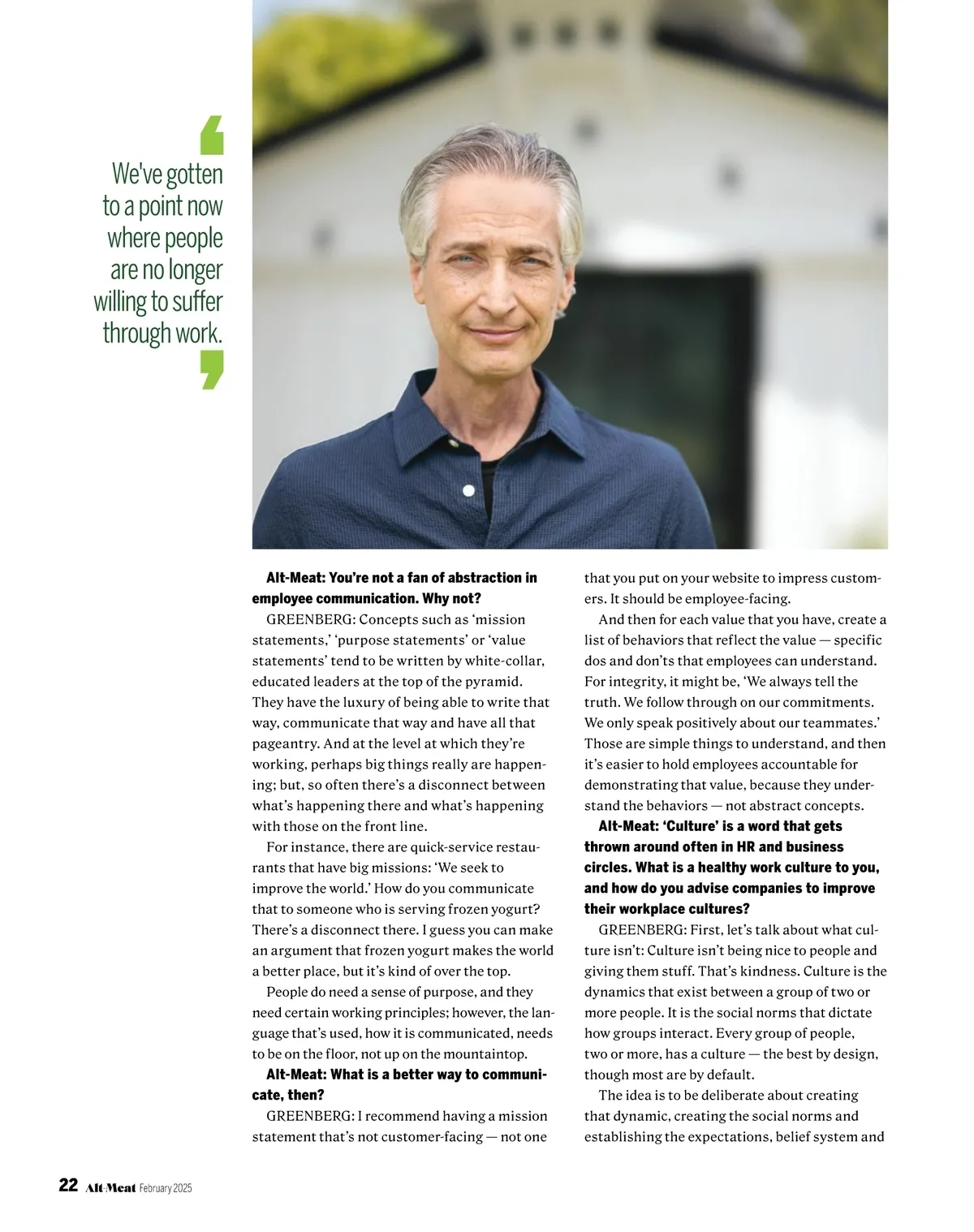
We've gotten to a point now where people are no longer willing to suffer through work. Alt-Meat: You’re not a fan of abstraction in employee communication. Why not? GREENBERG: Concepts such as ‘mission statements,’ ‘purpose statements’ or ‘value statements’ tend to be written by white-collar, educated leaders at the top of the pyramid. They have the luxury of being able to write that way, communicate that way and have all that pageantry. And at the level at which they’re working, perhaps big things really are happen-ing; but, so often there’s a disconnect between what’s happening there and what’s happening with those on the front line. For instance, there are quick-service restau-rants that have big missions: ‘We seek to improve the world.’ How do you communicate that to someone who is serving frozen yogurt? There’s a disconnect there. I guess you can make an argument that frozen yogurt makes the world a better place, but it’s kind of over the top. People do need a sense of purpose, and they need certain working principles; however, the lan-guage that’s used, how it is communicated, needs to be on the floor, not up on the mountaintop. that you put on your website to impress custom-ers. It should be employee-facing. And then for each value that you have, create a list of behaviors that reflect the value — specific dos and don’ts that employees can understand. For integrity, it might be, ‘We always tell the truth. We follow through on our commitments. We only speak positively about our teammates.’ Those are simple things to understand, and then it’s easier to hold employees accountable for demonstrating that value, because they under-stand the behaviors — not abstract concepts. Alt-Meat: ‘Culture’ is a word that gets thrown around often in HR and business circles. What is a healthy work culture to you, and how do you advise companies to improve their workplace cultures? GREENBERG: First, let’s talk about what cul-ture isn’t: Culture isn’t being nice to people and giving them stuff. That’s kindness. Culture is the dynamics that exist between a group of two or more people. It is the social norms that dictate how groups interact. Every group of people, two or more, has a culture — the best by design, though most are by default. The idea is to be deliberate about creating that dynamic, creating the social norms and establishing the expectations, belief system and Alt-Meat: What is a better way to communi-cate, then? GREENBERG: I recommend having a mission statement that’s not customer-facing — not one 22 Alt-Meat February 2025
Alt-Meat February 2025: Page 22