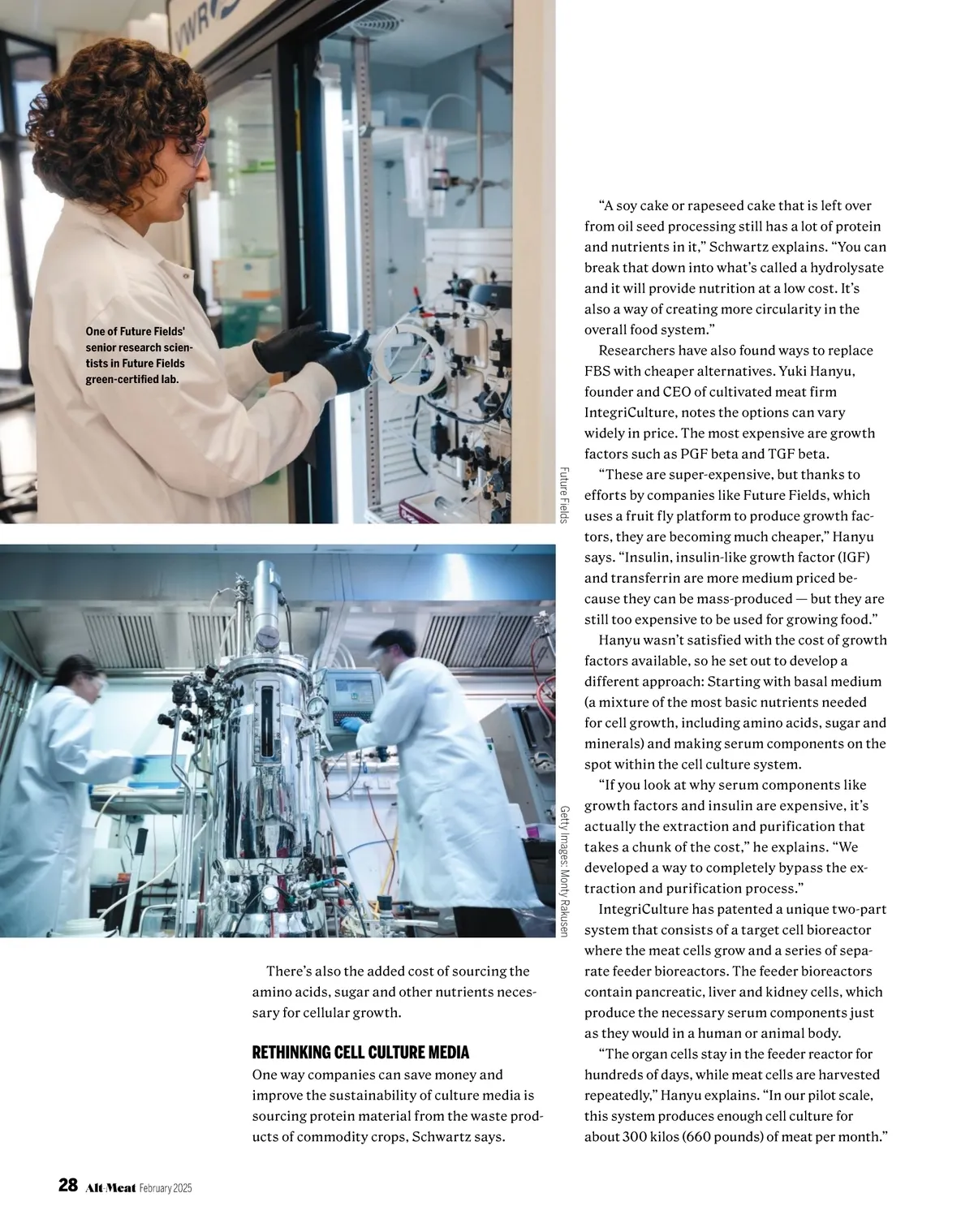
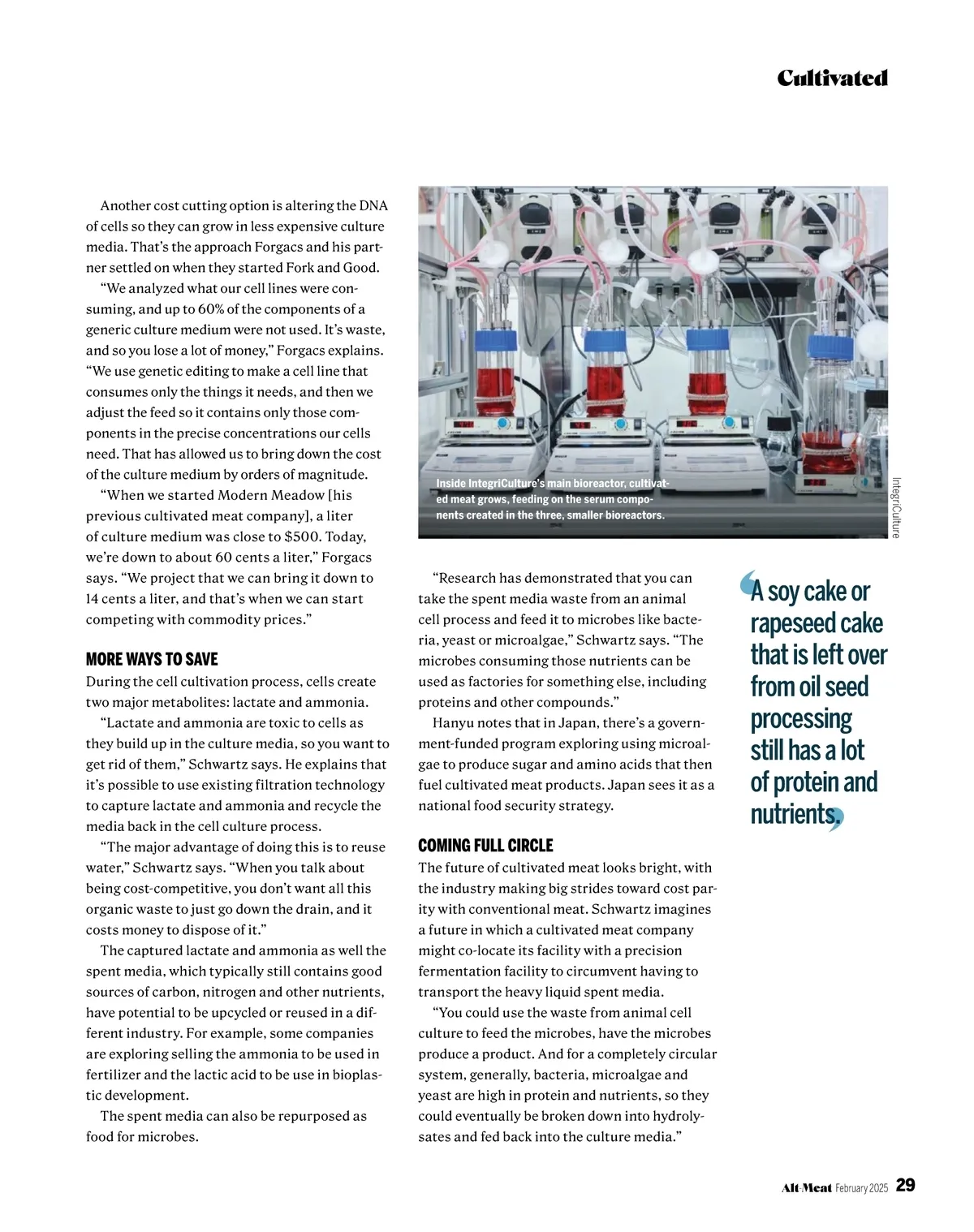
Cultivated Another cost cutting option is altering the DNA of cells so they can grow in less expensive culture media. That’s the approach Forgacs and his part-ner settled on when they started Fork and Good. “We analyzed what our cell lines were con-suming, and up to 60% of the components of a generic culture medium were not used. It’s waste, and so you lose a lot of money,” Forgacs explains. “We use genetic editing to make a cell line that consumes only the things it needs, and then we adjust the feed so it contains only those com-ponents in the precise concentrations our cells need. That has allowed us to bring down the cost of the culture medium by orders of magnitude. “When we started Modern Meadow [his previous cultivated meat company], a liter of culture medium was close to $500. Today, we’re down to about 60 cents a liter,” Forgacs says. “We project that we can bring it down to 14 cents a liter, and that’s when we can start competing with commodity prices.” “Research has demonstrated that you can take the spent media waste from an animal cell process and feed it to microbes like bacte-ria, yeast or microalgae,” Schwartz says. “The microbes consuming those nutrients can be used as factories for something else, including proteins and other compounds.” Hanyu notes that in Japan, there’s a govern-ment-funded program exploring using microal-gae to produce sugar and amino acids that then fuel cultivated meat products. Japan sees it as a national food security strategy. Inside IntegriCulture’s main bioreactor, cultivat-ed meat grows, feeding on the serum compo-nents created in the three, smaller bioreactors. IntegriCulture MORE WAYS TO SAVE During the cell cultivation process, cells create two major metabolites: lactate and ammonia. “Lactate and ammonia are toxic to cells as they build up in the culture media, so you want to get rid of them,” Schwartz says. He explains that it’s possible to use existing filtration technology to capture lactate and ammonia and recycle the media back in the cell culture process. “The major advantage of doing this is to reuse water,” Schwartz says. “When you talk about being cost-competitive, you don’t want all this organic waste to just go down the drain, and it costs money to dispose of it.” The captured lactate and ammonia as well the spent media, which typically still contains good sources of carbon, nitrogen and other nutrients, have potential to be upcycled or reused in a dif-ferent industry. For example, some companies are exploring selling the ammonia to be used in fertilizer and the lactic acid to be use in bioplas-tic development. The spent media can also be repurposed as food for microbes. A soy cake or rapeseed cake that is left over from oil seed processing still has a lot of protein and nutrients. COMING FULL CIRCLE The future of cultivated meat looks bright, with the industry making big strides toward cost par-ity with conventional meat. Schwartz imagines a future in which a cultivated meat company might co-locate its facility with a precision fermentation facility to circumvent having to transport the heavy liquid spent media. “You could use the waste from animal cell culture to feed the microbes, have the microbes produce a product. And for a completely circular system, generally, bacteria, microalgae and yeast are high in protein and nutrients, so they could eventually be broken down into hydroly-sates and fed back into the culture media.” Alt-Meat February 2025 29
Alt-Meat February 2025: Page 29