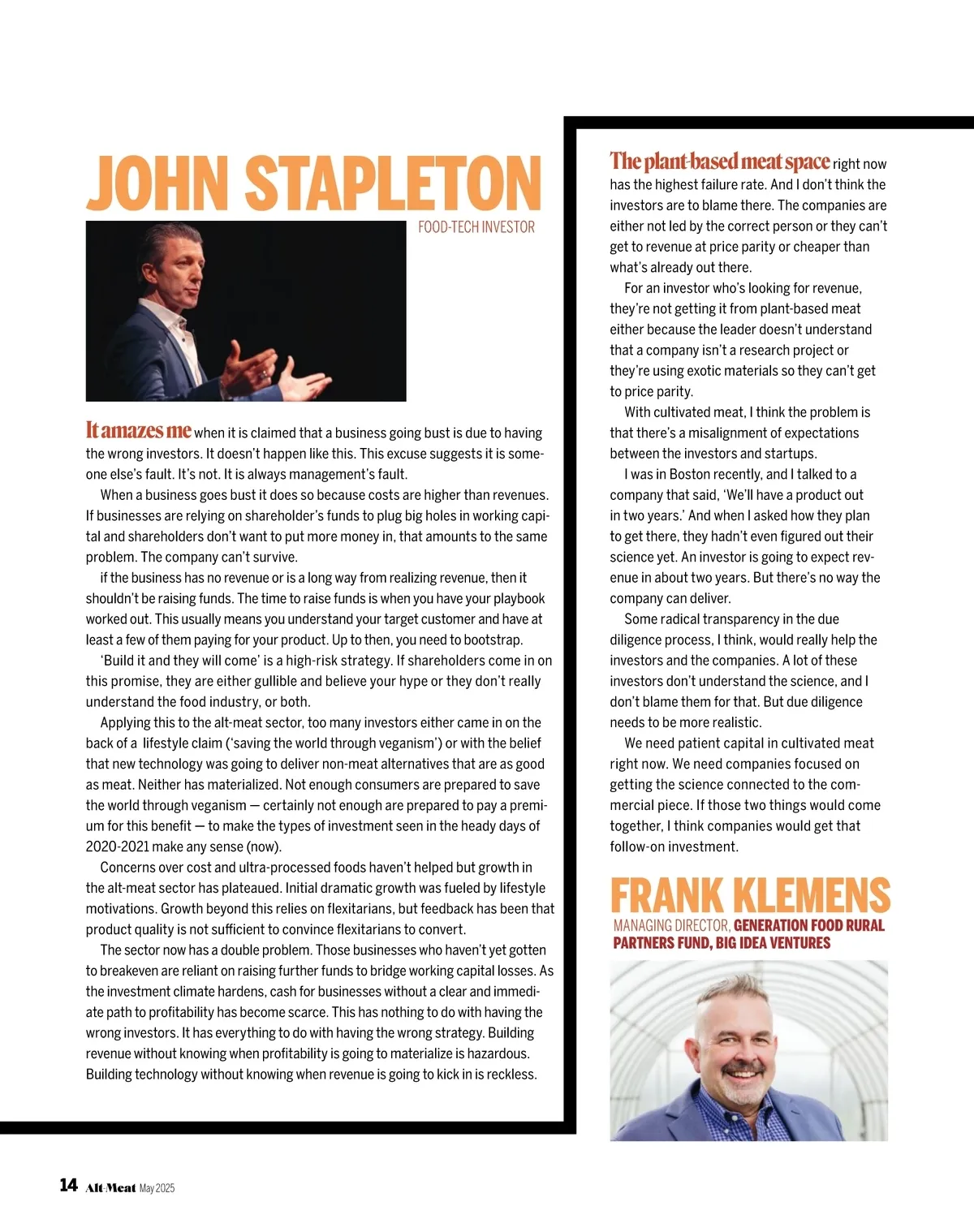
JOHN STAPLETON FOOD-TECH INVESTOR It amazes me when it is claimed that a business going bust is due to having the wrong investors. It doesn’t happen like this. This excuse suggests it is some-one else’s fault. It’s not. It is always management’s fault. When a business goes bust it does so because costs are higher than revenues. If businesses are relying on shareholder’s funds to plug big holes in working capi-tal and shareholders don’t want to put more money in, that amounts to the same problem. The company can’t survive. if the business has no revenue or is a long way from realizing revenue, then it shouldn’t be raising funds. The time to raise funds is when you have your playbook worked out. This usually means you understand your target customer and have at least a few of them paying for your product. Up to then, you need to bootstrap. ‘Build it and they will come’ is a high-risk strategy. If shareholders come in on this promise, they are either gullible and believe your hype or they don’t really understand the food industry, or both. Applying this to the alt-meat sector, too many investors either came in on the back of a lifestyle claim (‘saving the world through veganism’) or with the belief that new technology was going to deliver non-meat alternatives that are as good as meat. Neither has materialized. Not enough consumers are prepared to save the world through veganism — certainly not enough are prepared to pay a premi-um for this benefit — to make the types of investment seen in the heady days of 2020-2021 make any sense (now). Concerns over cost and ultra-processed foods haven’t helped but growth in the alt-meat sector has plateaued. Initial dramatic growth was fueled by lifestyle motivations. Growth beyond this relies on flexitarians, but feedback has been that product quality is not sufficient to convince flexitarians to convert. The sector now has a double problem. Those businesses who haven’t yet gotten to breakeven are reliant on raising further funds to bridge working capital losses. As the investment climate hardens, cash for businesses without a clear and immedi-ate path to profitability has become scarce. This has nothing to do with having the wrong investors. It has everything to do with having the wrong strategy. Building revenue without knowing when profitability is going to materialize is hazardous. Building technology without knowing when revenue is going to kick in is reckless. The plant-based meat space right now has the highest failure rate. And I don’t think the investors are to blame there. The companies are either not led by the correct person or they can’t get to revenue at price parity or cheaper than what’s already out there. For an investor who’s looking for revenue, they’re not getting it from plant-based meat either because the leader doesn’t understand that a company isn’t a research project or they’re using exotic materials so they can’t get to price parity. With cultivated meat, I think the problem is that there’s a misalignment of expectations between the investors and startups. I was in Boston recently, and I talked to a company that said, ‘We’ll have a product out in two years.’ And when I asked how they plan to get there, they hadn’t even figured out their science yet. An investor is going to expect rev-enue in about two years. But there’s no way the company can deliver. Some radical transparency in the due diligence process, I think, would really help the investors and the companies. A lot of these investors don’t understand the science, and I don’t blame them for that. But due diligence needs to be more realistic. We need patient capital in cultivated meat right now. We need companies focused on getting the science connected to the com-mercial piece. If those two things would come together, I think companies would get that follow-on investment. FRANK KLEMENS MANAGING DIRECTOR, GENERATION FOOD RURAL PARTNERS FUND, BIG IDEA VENTURES 14 Alt-Meat May 2025
Alt-Meat May 2025: Page 14