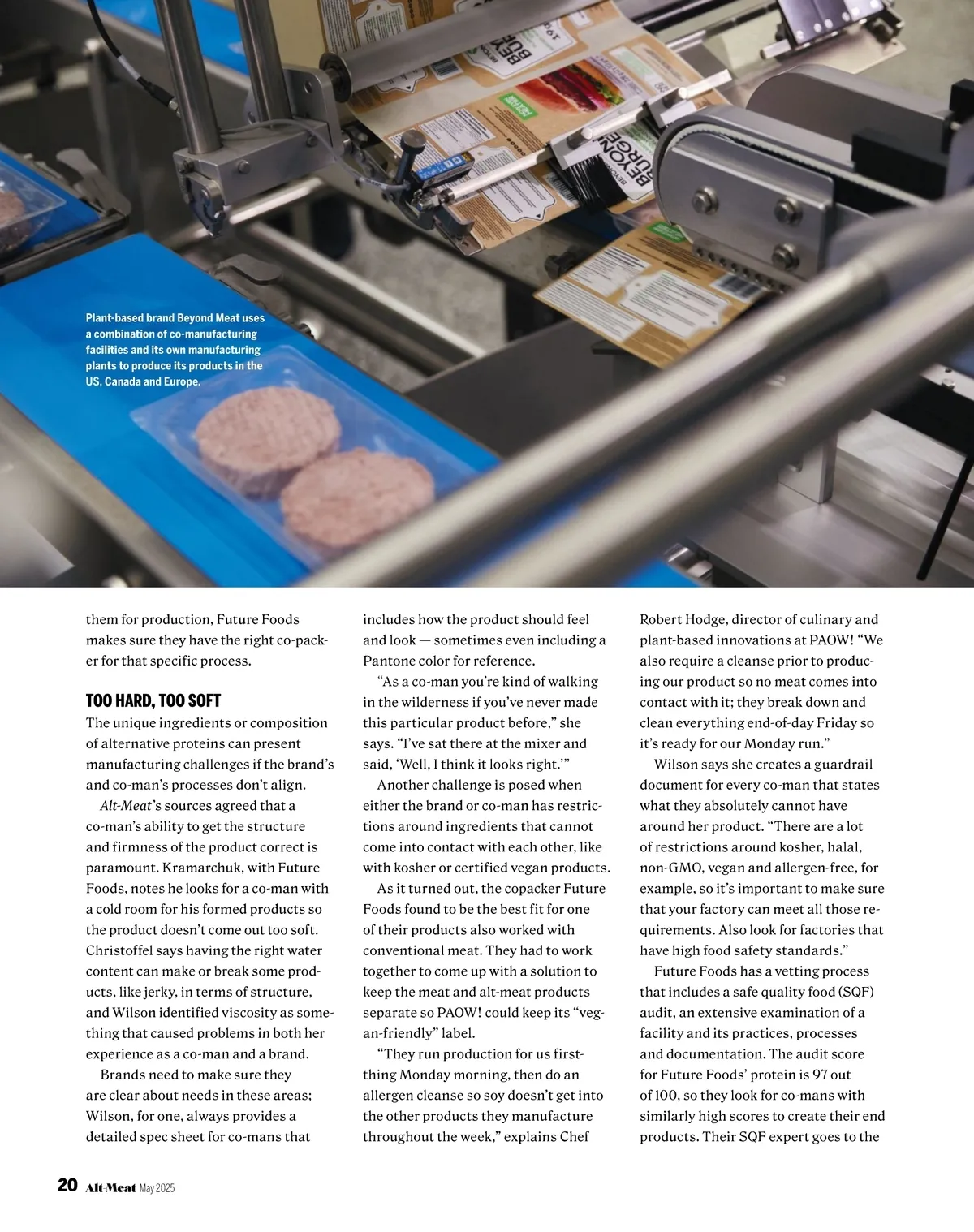
Manufacturing Plant-based brand Beyond Meat uses a combination of co-manufacturing facilities and its own manufacturing plants to produce its products in the US, Canada and Europe. them for production, Future Foods makes sure they have the right co-pack-er for that specific process. includes how the product should feel and look — sometimes even including a Pantone color for reference. “As a co-man you’re kind of walking in the wilderness if you’ve never made this particular product before,” she says. “I’ve sat there at the mixer and said, ‘Well, I think it looks right.’” Another challenge is posed when either the brand or co-man has restric-tions around ingredients that cannot come into contact with each other, like with kosher or certified vegan products. As it turned out, the copacker Future Foods found to be the best fit for one of their products also worked with conventional meat. They had to work together to come up with a solution to keep the meat and alt-meat products separate so PAOW! could keep its “veg-an-friendly” label. “They run production for us first-thing Monday morning, then do an allergen cleanse so soy doesn’t get into the other products they manufacture throughout the week,” explains Chef Robert Hodge, director of culinary and plant-based innovations at PAOW! “We also require a cleanse prior to produc-ing our product so no meat comes into contact with it; they break down and clean everything end-of-day Friday so it’s ready for our Monday run.” Wilson says she creates a guardrail document for every co-man that states what they absolutely cannot have around her product. “There are a lot of restrictions around kosher, halal, non-GMO, vegan and allergen-free, for example, so it’s important to make sure that your factory can meet all those re-quirements. Also look for factories that have high food safety standards.” Future Foods has a vetting process that includes a safe quality food (SQF) audit, an extensive examination of a facility and its practices, processes and documentation. The audit score for Future Foods’ protein is 97 out of 100, so they look for co-mans with similarly high scores to create their end products. Their SQF expert goes to the TOO HARD, TOO SOFT The unique ingredients or composition of alternative proteins can present manufacturing challenges if the brand’s and co-man’s processes don’t align. Alt-Meat ’s sources agreed that a co-man’s ability to get the structure and firmness of the product correct is paramount. Kramarchuk, with Future Foods, notes he looks for a co-man with a cold room for his formed products so the product doesn’t come out too soft. Christoffel says having the right water content can make or break some prod-ucts, like jerky, in terms of structure, and Wilson identified viscosity as some-thing that caused problems in both her experience as a co-man and a brand. Brands need to make sure they are clear about needs in these areas; Wilson, for one, always provides a detailed spec sheet for co-mans that 20 Alt-Meat May 2025
Alt-Meat May 2025: Page 20