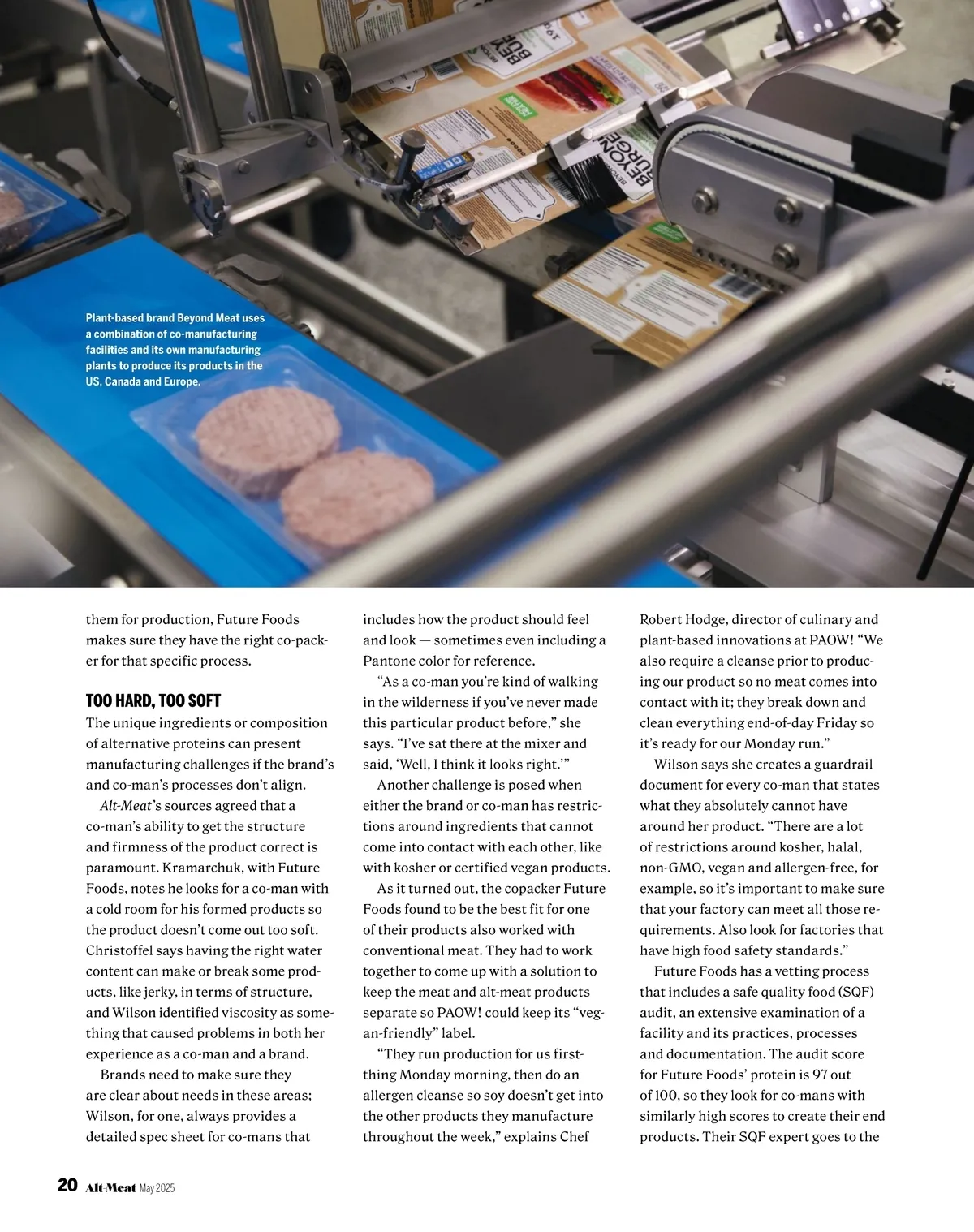
Manufacturing learning how to be a manufacturer is hard. co-man to review, then recommends changes to meet the company’s stan-dards or advises that they’re not a fit. “If I’m entrusting my product to a third party’s product line, my safety guy is going to make sure they can maintain our standards,” says Kramarchuk, not-ing they have people on site monitoring every production run. brands with co-mans through Ricardo Food Group. He has established rela-tionships with more than 700 manufac-turers across the country and describes his role as “making marriages” between brands and manufacturers. His team asks hundreds of ques-tions before pairing a brand with a manufacturer. Once the relationship is established, he’ll also negotiate pricing and other terms. On pricing and payment, a brand can go one of two ways: tolling agreements or turnkey. For tolling agreements, the customer buys all the ingredients and ships them to the co-man to manu-facture. The co-man then returns the product to the brand for distribution. Cordaro is not usually in favor of tolling arrangements because larger contract manufacturers bring in ingredients every day and have greater purchasing power. That often leaves room to nego-tiate lower prices for the customer. “When I look for a manufacturer for a brand, I want one that already regularly uses at least 60% of the brand’s needed ingredients,” Cordaro says. Furthermore, while tolling costs may seem lower at face value, when considering the sort of minimum order quantities typical of a start-up, inven-tory holding costs can add up — an often-overlooked cost of doing busi-ness. Brands need to either work with a co-man that has space to store inputs or have their own storage facility. “If you don’t have the volume and the co-packer doesn’t have the ability to downscale, expect to buy a bigger lot size. Then you have to store that product somewhere until you’re ready to use it,” Kramarchuk says. Alt-meat companies also may have to negotiate around standard payment terms, especially when cashflow is low. “Co-packers usually need 50% payment before they start the work,” Kramarchuk explains. “For some of the smaller companies trying to find co-packers, that becomes a barrier to entry because there has to be revenue coming in to pay bills. A lot of these companies will say, ‘Hey, I can’t pay the bills until we start selling some of this product,’ and will have to work that out with the co-man.” If you’re an innovator launching new products, HOT OR COLD It’s also critical to assess the potential interpersonal relationship for good chemistry, making sure the people managing that relationship between brand and co-man will be comfortable working together closely and regularly. The type and frequency of communi-cation should be discussed and agreed upon at the start of the relationship. If a brand prefers to have people onsite regularly or call and check in frequently and the co-man finds that to be too much, the two are not a good fit. For example, while Kramarchuk wants that constant contact with the product, Wilson would find that kind of relationship overbearing. “You know, some companies say, ‘I want to have my person standing there for every production run to make sure it meets my standards,’” Wilson explains. “I never loved that when I was a con-tract manufacturer; it felt very much like having the teacher stand over you during a test.” Some brands choose to work with third parties to find a co-man and main-tain the ongoing relationship. Cordaro uses his experience as an ex-ecutive chef and manufacturer to match JUST RIGHT Ultimately, contract manufacturing can be an efficient, economical solution for alt-protein companies looking to focus on R&D, sales and marketing rather than on being manufacturing experts. Since a relationship with a co-man affects the brand’s quality and repu-tation, it’s critical to take time to find a co-man whose people, process and ideals align with the alt-meat brand’s. Trying to rush the process as part of a startup timeline could cost a brand time and money down the road. And if your co-man has any safety or quality issues, it could damage the product’s reputation beyond repair before it gets off the ground. Like Goldilocks, at the end of the day, brands should feel “just right” with their co-man. As Cordaro says, “You’re building what is usually a long relationship, so you want to be sure it’s going to be a good fit.” Alt-Meat May 2025 21
Alt-Meat May 2025: Page 21