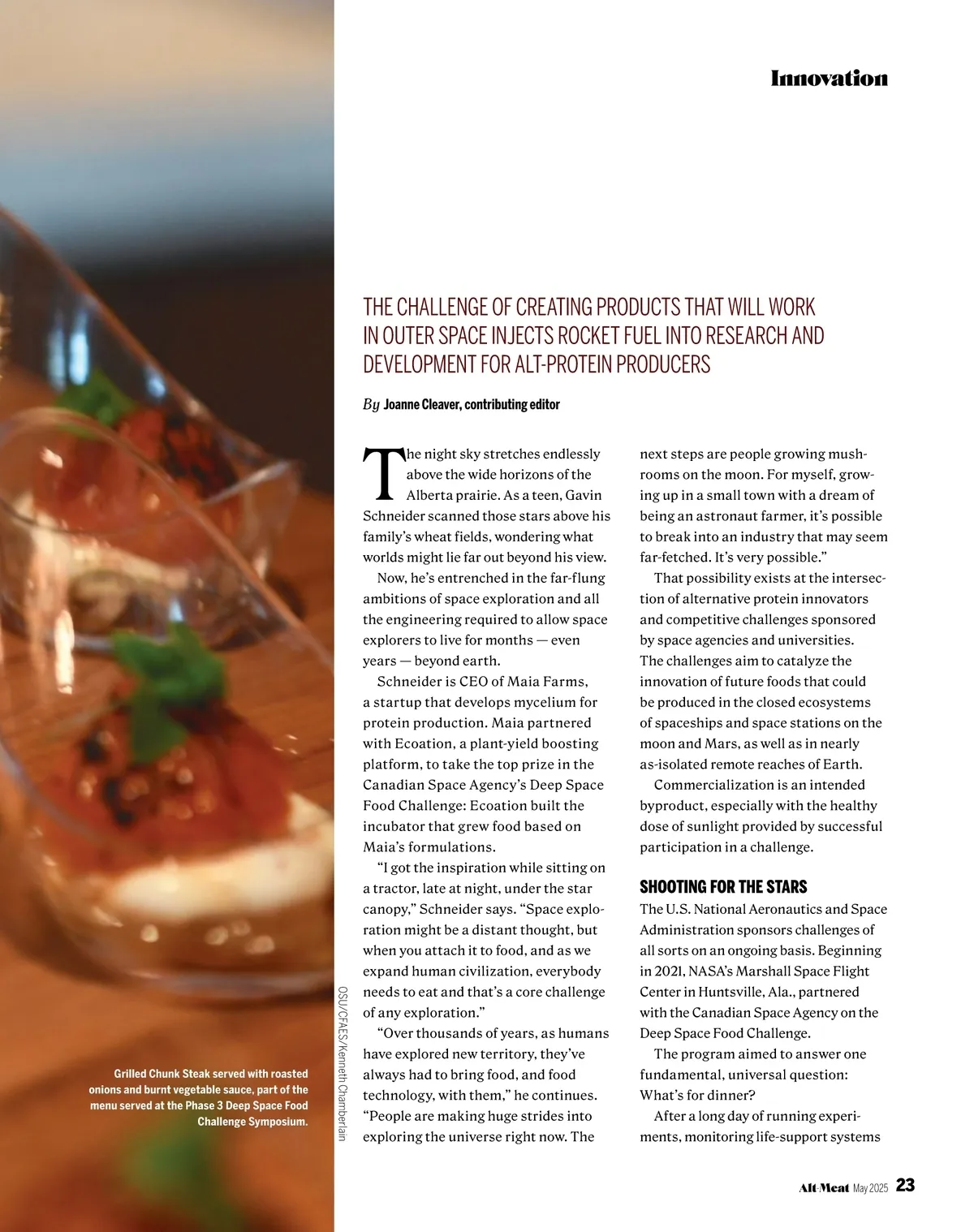
Innovation THE CHALLENGE OF CREATING PRODUCTS THAT WILL WORK IN OUTER SPACE INJECTS ROCKET FUEL INTO RESEARCH AND DEVELOPMENT FOR ALT-PROTEIN PRODUCERS By Joanne Cleaver, contributing editor T he night sky stretches endlessly above the wide horizons of the Alberta prairie. As a teen, Gavin next steps are people growing mush-rooms on the moon. For myself, grow-ing up in a small town with a dream of being an astronaut farmer, it’s possible to break into an industry that may seem far-fetched. It’s very possible.” That possibility exists at the intersec-tion of alternative protein innovators and competitive challenges sponsored by space agencies and universities. The challenges aim to catalyze the innovation of future foods that could be produced in the closed ecosystems of spaceships and space stations on the moon and Mars, as well as in nearly as-isolated remote reaches of Earth. Commercialization is an intended byproduct, especially with the healthy dose of sunlight provided by successful participation in a challenge. Schneider scanned those stars above his family’s wheat fields, wondering what worlds might lie far out beyond his view. Now, he’s entrenched in the far-flung ambitions of space exploration and all the engineering required to allow space explorers to live for months — even years — beyond earth. Schneider is CEO of Maia Farms, a startup that develops mycelium for protein production. Maia partnered with Ecoation, a plant-yield boosting platform, to take the top prize in the Canadian Space Agency’s Deep Space Food Challenge: Ecoation built the incubator that grew food based on Maia’s formulations. “I got the inspiration while sitting on a tractor, late at night, under the star canopy,” Schneider says. “Space explo-ration might be a distant thought, but when you attach it to food, and as we expand human civilization, everybody needs to eat and that’s a core challenge of any exploration.” “Over thousands of years, as humans have explored new territory, they’ve always had to bring food, and food technology, with them,” he continues. “People are making huge strides into exploring the universe right now. The SHOOTING FOR THE STARS The U.S. National Aeronautics and Space Administration sponsors challenges of all sorts on an ongoing basis. Beginning in 2021, NASA’s Marshall Space Flight Center in Huntsville, Ala., partnered with the Canadian Space Agency on the Deep Space Food Challenge. The program aimed to answer one fundamental, universal question: What’s for dinner? After a long day of running experi-ments, monitoring life-support systems Alt-Meat May 2025 OSU/CFAES/Kenneth Chamberlain Grilled Chunk Steak served with roasted onions and burnt vegetable sauce, part of the menu served at the Phase 3 Deep Space Food Challenge Symposium. 23
Alt-Meat May 2025: Page 23