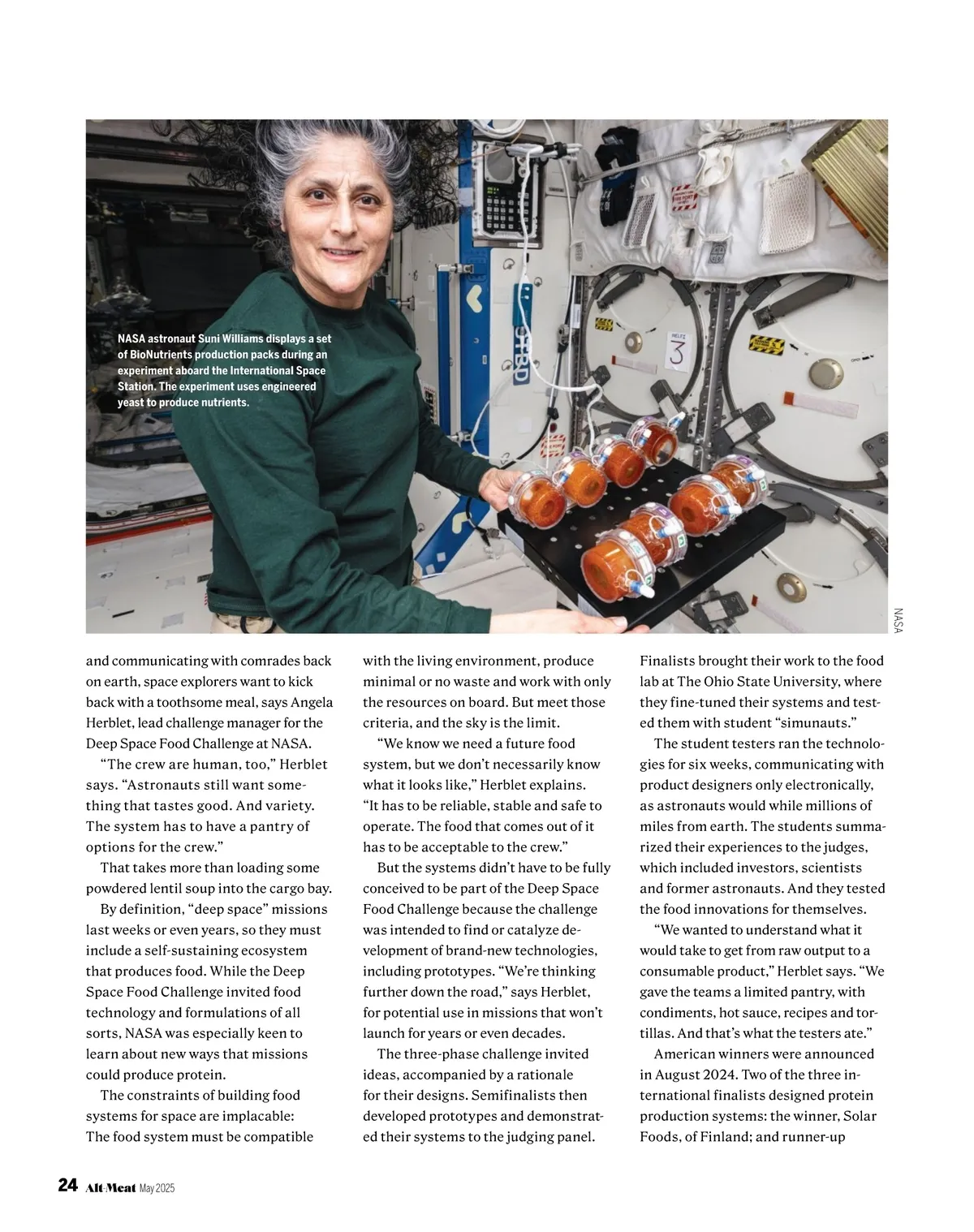
NASA astronaut Suni Williams displays a set of BioNutrients production packs during an experiment aboard the International Space Station. The experiment uses engineered yeast to produce nutrients. NASA and communicating with comrades back on earth, space explorers want to kick back with a toothsome meal, says Angela Herblet, lead challenge manager for the Deep Space Food Challenge at NASA. “The crew are human, too,” Herblet says. “Astronauts still want some-thing that tastes good. And variety. The system has to have a pantry of options for the crew.” That takes more than loading some powdered lentil soup into the cargo bay. By definition, “deep space” missions last weeks or even years, so they must include a self-sustaining ecosystem that produces food. While the Deep Space Food Challenge invited food technology and formulations of all sorts, NASA was especially keen to learn about new ways that missions could produce protein. The constraints of building food systems for space are implacable: The food system must be compatible with the living environment, produce minimal or no waste and work with only the resources on board. But meet those criteria, and the sky is the limit. “We know we need a future food system, but we don’t necessarily know what it looks like,” Herblet explains. “It has to be reliable, stable and safe to operate. The food that comes out of it has to be acceptable to the crew.” But the systems didn’t have to be fully conceived to be part of the Deep Space Food Challenge because the challenge was intended to find or catalyze de-velopment of brand-new technologies, including prototypes. “We’re thinking further down the road,” says Herblet, for potential use in missions that won’t launch for years or even decades. The three-phase challenge invited ideas, accompanied by a rationale for their designs. Semifinalists then developed prototypes and demonstrat-ed their systems to the judging panel. Finalists brought their work to the food lab at The Ohio State University, where they fine-tuned their systems and test-ed them with student “simunauts.” The student testers ran the technolo-gies for six weeks, communicating with product designers only electronically, as astronauts would while millions of miles from earth. The students summa-rized their experiences to the judges, which included investors, scientists and former astronauts. And they tested the food innovations for themselves. “We wanted to understand what it would take to get from raw output to a consumable product,” Herblet says. “We gave the teams a limited pantry, with condiments, hot sauce, recipes and tor-tillas. And that’s what the testers ate.” American winners were announced in August 2024. Two of the three in-ternational finalists designed protein production systems: the winner, Solar Foods, of Finland; and runner-up 24 Alt-Meat May 2025
Alt-Meat May 2025: Page 24