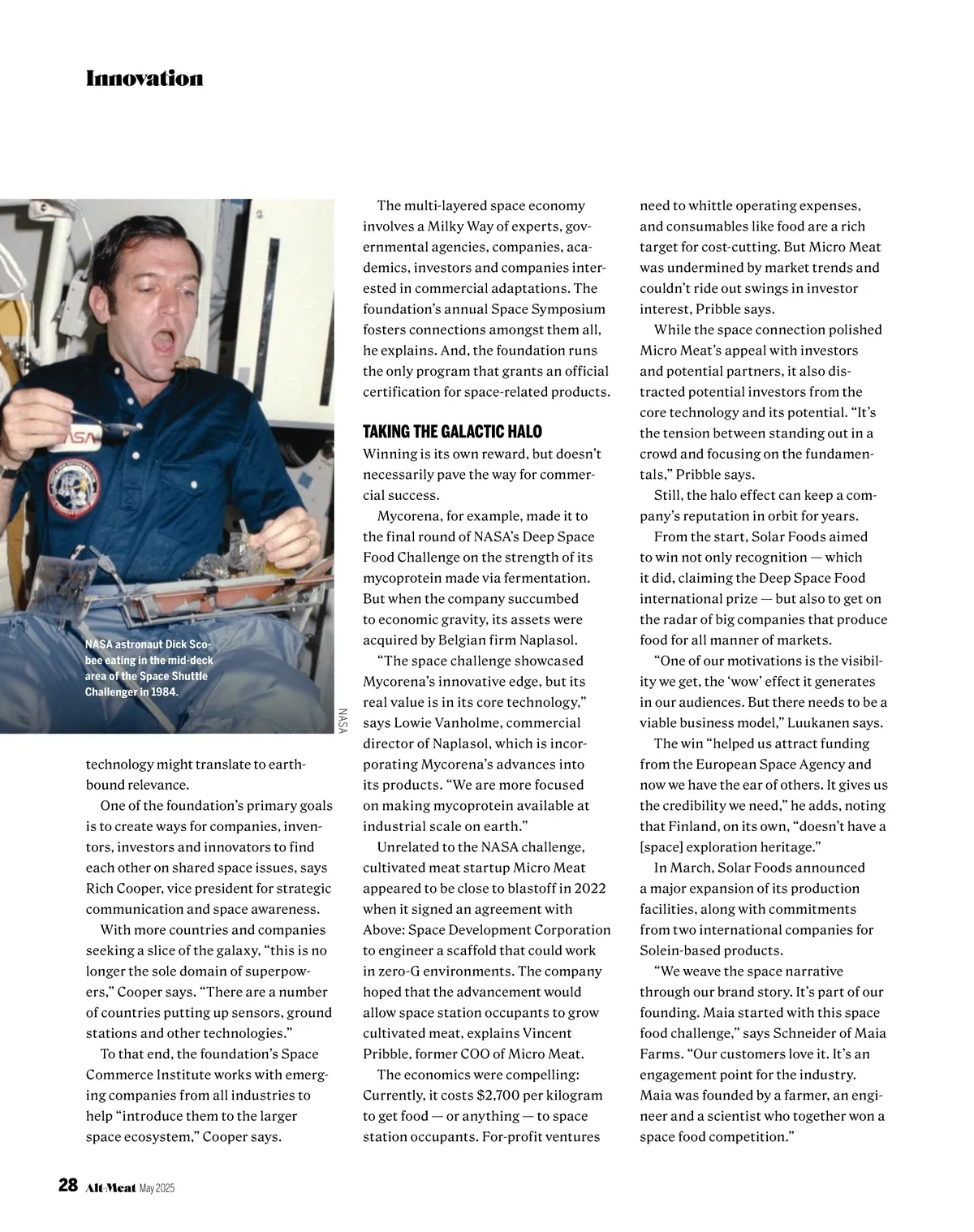
Innovation The multi-layered space economy involves a Milky Way of experts, gov-ernmental agencies, companies, aca-demics, investors and companies inter-ested in commercial adaptations. The foundation’s annual Space Symposium fosters connections amongst them all, he explains. And, the foundation runs the only program that grants an official certification for space-related products. need to whittle operating expenses, and consumables like food are a rich target for cost-cutting. But Micro Meat was undermined by market trends and couldn’t ride out swings in investor interest, Pribble says. While the space connection polished Micro Meat’s appeal with investors and potential partners, it also dis-tracted potential investors from the core technology and its potential. “It’s the tension between standing out in a crowd and focusing on the fundamen-tals,” Pribble says. Still, the halo effect can keep a com-pany’s reputation in orbit for years. From the start, Solar Foods aimed to win not only recognition — which it did, claiming the Deep Space Food international prize — but also to get on the radar of big companies that produce food for all manner of markets. “One of our motivations is the visibil-ity we get, the ‘wow’ effect it generates in our audiences. But there needs to be a viable business model,” Luukanen says. The win “helped us attract funding from the European Space Agency and now we have the ear of others. It gives us the credibility we need,” he adds, noting that Finland, on its own, “doesn’t have a [space] exploration heritage.” In March, Solar Foods announced a major expansion of its production facilities, along with commitments from two international companies for Solein-based products. “We weave the space narrative through our brand story. It’s part of our founding. Maia started with this space food challenge,” says Schneider of Maia Farms. “Our customers love it. It’s an engagement point for the industry. Maia was founded by a farmer, an engi-neer and a scientist who together won a space food competition.” TAKING THE GALACTIC HALO Winning is its own reward, but doesn’t necessarily pave the way for commer-cial success. Mycorena, for example, made it to the final round of NASA’s Deep Space Food Challenge on the strength of its mycoprotein made via fermentation. But when the company succumbed to economic gravity, its assets were NASA astronaut Dick Sco-bee eating in the mid-deck area of the Space Shuttle Challenger in 1984. NASA acquired by Belgian firm Naplasol. “The space challenge showcased Mycorena’s innovative edge, but its real value is in its core technology,” says Lowie Vanholme, commercial director of Naplasol, which is incor-porating Mycorena’s advances into its products. “We are more focused on making mycoprotein available at industrial scale on earth.” Unrelated to the NASA challenge, cultivated meat startup Micro Meat appeared to be close to blastoff in 2022 when it signed an agreement with Above: Space Development Corporation to engineer a scaffold that could work in zero-G environments. The company hoped that the advancement would allow space station occupants to grow cultivated meat, explains Vincent Pribble, former COO of Micro Meat. The economics were compelling: Currently, it costs $2,700 per kilogram to get food — or anything — to space station occupants. For-profit ventures technology might translate to earth-bound relevance. One of the foundation’s primary goals is to create ways for companies, inven-tors, investors and innovators to find each other on shared space issues, says Rich Cooper, vice president for strategic communication and space awareness. With more countries and companies seeking a slice of the galaxy, “this is no longer the sole domain of superpow-ers,” Cooper says. “There are a number of countries putting up sensors, ground stations and other technologies.” To that end, the foundation’s Space Commerce Institute works with emerg-ing companies from all industries to help “introduce them to the larger space ecosystem,” Cooper says. 28 Alt-Meat May 2025
Alt-Meat May 2025: Page 28