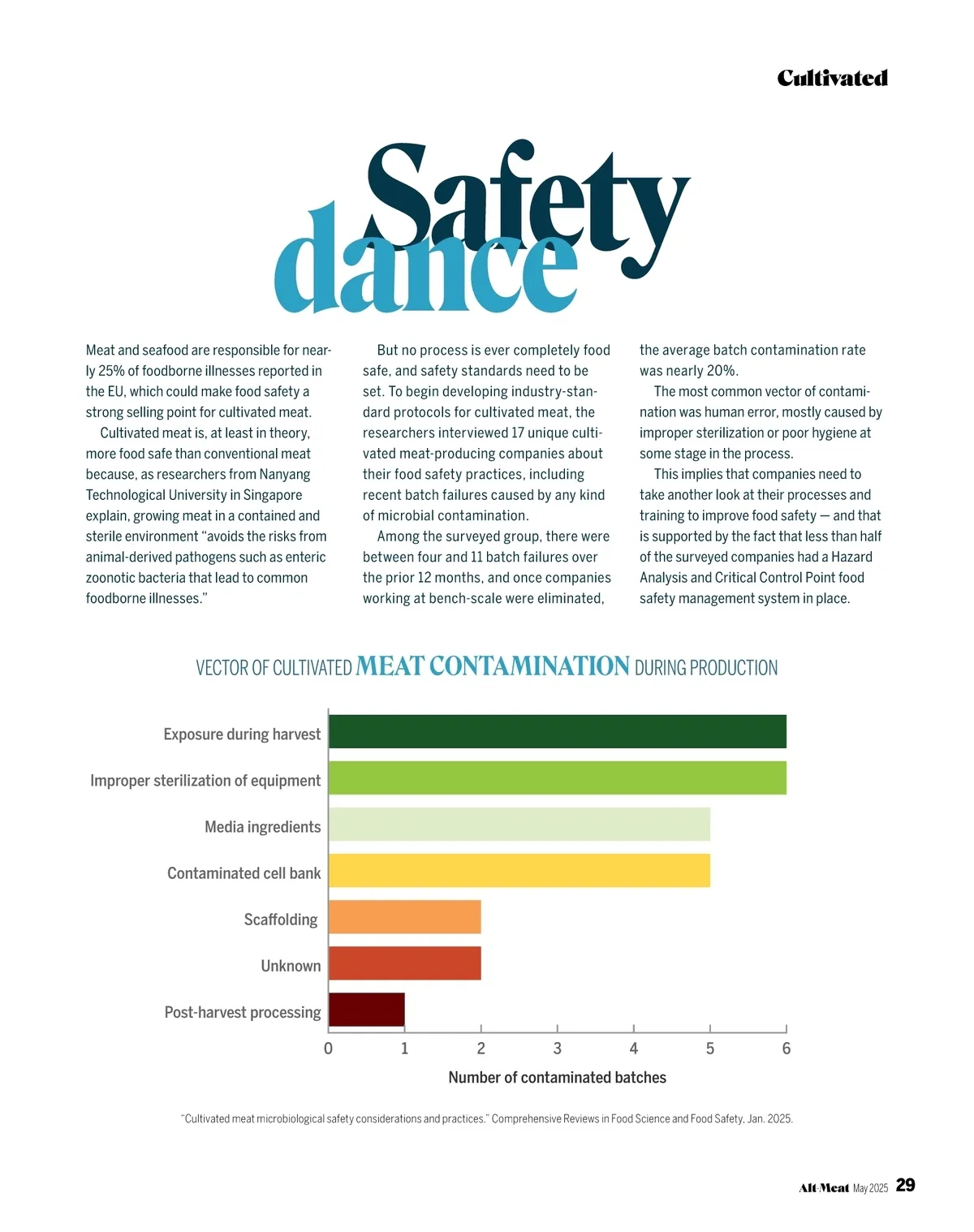
Meat and seafood are responsible for near-ly 25% of foodborne illnesses reported in the EU, which could make food safety a strong selling point for cultivated meat. Cultivated meat is, at least in theory, more food safe than conventional meat because, as researchers from Nanyang Technological University in Singapore explain, growing meat in a contained and sterile environment “avoids the risks from animal-derived pathogens such as enteric zoonotic bacteria that lead to common foodborne illnesses.” Safety dance But no process is ever completely food safe, and safety standards need to be set. To begin developing industry-stan-dard protocols for cultivated meat, the researchers interviewed 17 unique culti-vated meat-producing companies about their food safety practices, including recent batch failures caused by any kind of microbial contamination. Among the surveyed group, there were between four and 11 batch failures over the prior 12 months, and once companies working at bench-scale were eliminated, Cultivated the average batch contamination rate was nearly 20%. The most common vector of contami-nation was human error, mostly caused by improper sterilization or poor hygiene at some stage in the process. This implies that companies need to take another look at their processes and training to improve food safety — and that is supported by the fact that less than half of the surveyed companies had a Hazard Analysis and Critical Control Point food safety management system in place. VECTOR OF CULTIVATED MEAT CONTAMINATION DURING PRODUCTION Exposure during harvest Improper sterilization of equipment Media ingredients Contaminated cell bank Scaffolding Unknown Post-harvest processing 0 1 2 3 4 5 6 Number of contaminated batches “Cultivated meat microbiological safety considerations and practices.” Comprehensive Reviews in Food Science and Food Safety, Jan. 2025. Alt-Meat May 2025 29
Alt-Meat May 2025: Page 29