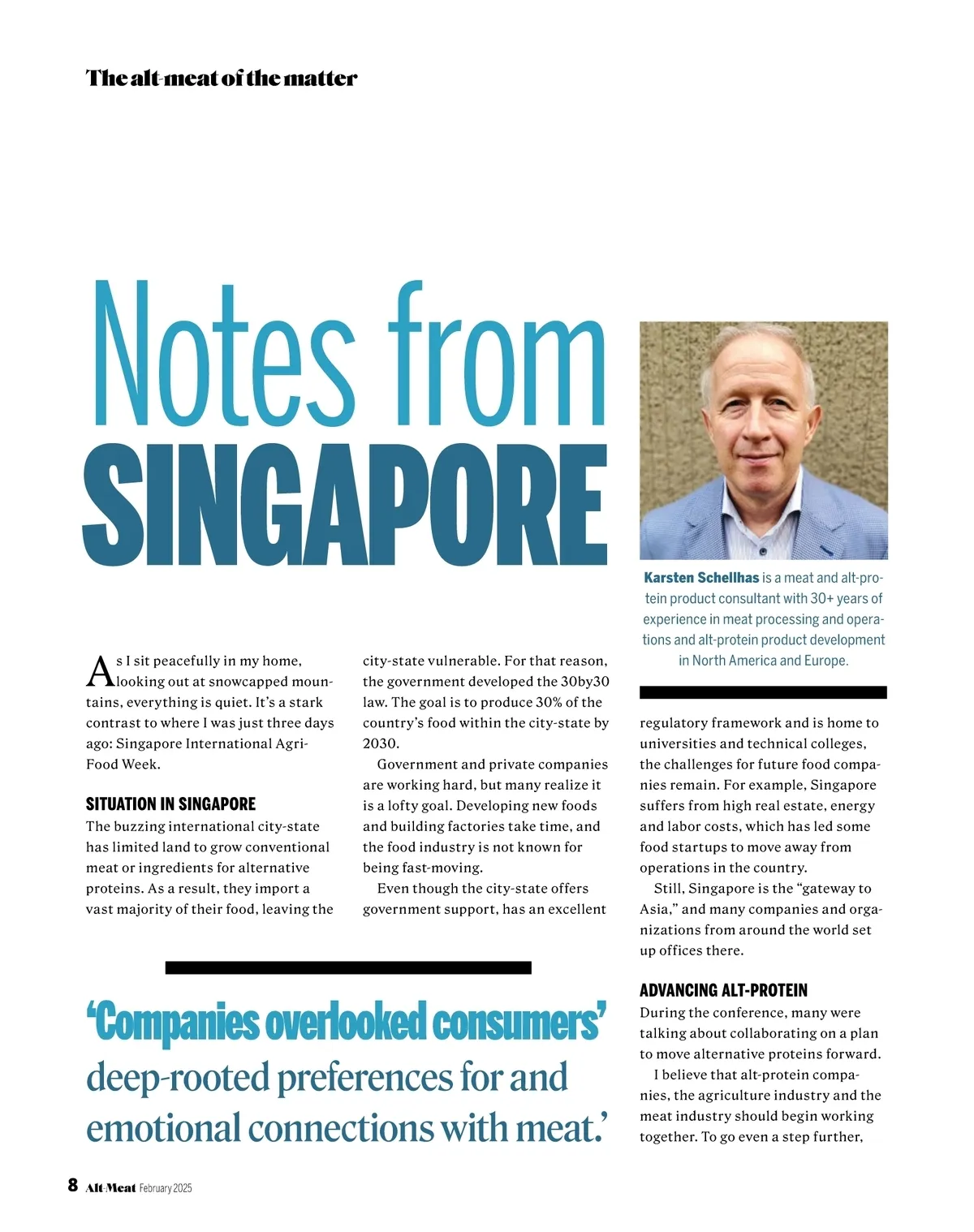
the industries should come together in conference to discuss the challenges and set a plan for advancing the new food economy. On that point, I’ve noted over the past 12 months that meat companies are beginning to send repre-sentation to alternative protein conferences. While cultivated meat technology and precision fermentation are moving ahead slowly, the plant-based sector is struggling. I believe it was a mistake to concentrate on sustain-ability and saving animals as key selling points from the beginning. These are important, sure, but com-panies neglected to work on price, taste and texture. And they overlooked con-sumers’ deep-rooted prefer-ences for and emotional connections with meat. Plant-based companies need to realize that they can’t escape the fundamen-tals. If you cannot produce a product that adds signifi-cant value to the customer and society, then your com-pany will cease to exist. interesting panel discus-sion on gut health and the microbiome — the ecosys-tem of bacteria that play a role in human health. A panel of three Singaporean doctors discussed how bad food with low nutritional value has a negative impact on the microbiome and overall health. For example, diabe-tes and kidney disease are rampant in Singapore. Since 2018, I’ve been saying that we need to gain a better understanding of how — or even if — our bodies can extract nutrients from the new foods we’ re creat-ing. Chalmers University released a study in 2022 saying that meat substitutes are often nutrient-deficient due to the quality of the raw materials, processing conditions and how many phytates (anti-nutrients) are in the end product. We des-perately need more research in that area. On another panel, an investor was asked what he wishes for in 2025. He said, “I’d like to see some of my portfolio companies sell more products and make a small profit. It all comes down to one thing: Show me the money!” Alt-Meat February 2025 BODY OF RESEARCH During the confer-ence, I also attended an 9
Alt-Meat February 2025: Page 9